skip to main |
skip to sidebar
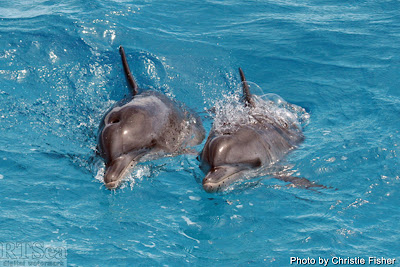 Another example of the problem with the indiscriminate nature of gill nets: ABC News reports that in South Australia, the Humane Society International is pitting itself against legally sanctioned shark fishing due to a recently high level of dolphin deaths. The commercial shark fishing operators use gill nets which are notorious for catching other marine life other than sharks. Seals, turtles, billfish, and dolphins have been known to get ensnared in gill nets and summarily discarded as bycatch.
 Apparently there has been a high accumulation of baitfish in South Australian waters where the shark fishermen operate. This has attracted dolphins, thereby increasing the number accidentally caught and killed in the gill nets. Shark fishing industry officials say they are not to blame as they are operating within all legal regulations. Regardless, Humane Society officials believe action needs to be taken immediately to protect the dolphins."It's not only a conservation issue, potentially it's also an animal welfare issue," said Alexia Wellbelove from the Humane Society. "What we're asking AFMA, the Australian Fisheries Management Authority, to do is put some measures in place to protect the dolphins. If those can't be put in place then the use of gill nets needs to be banned in that area until they can figure out what the problem is that's causing all these deaths, because it's totally unacceptable."
 The Humane Society International is recommending that dolphin experts be brought in to assist the AFMA and the fishery industry in determining a solution to the problem, rather than, in essence, blame the entire situation on the dolphins."What we need to do is actually get some dolphin experts to give the industry some advice," Wellbelove said. "I don't believe the industry has the capability or the understanding of dolphins sufficiently to be able to give us that information with any certainty."
 From the large and majestic humpback whale, mentioned in yesterday's post, we can travel to the other end of scale: the rare and diminutive Vaquita. Reaching a mere 5 feet in length, the vaquita is a member of the porpoise family and is only found in the northern end of the Sea of Cortez (Gulf of California). And at a scientific meeting of the International Whaling Commission being held in Agadir, Morocco, the findings of a 2008 population study show that there are only approximately 250 vaquitas alive today. As disturbing as that low number may seem, it is even more disconcerting when compared to a 1997 population study that estimated the population to be 567 - a decrease of 55% in just one decade.
The vaquita is similar to other small porpoise species that inhabit deltas and river outlets (one such species in China was considered extinct by 2007). Probably attracted to the shallows of the Sea of Cortez near the mouth of the Colorado River, the vaquita's habitat was impacted by the damming of the river in the U.S.; but researchers do not believe this has been a detriment to the vaquita. What appears to be the primary cause for the vaquita's decline is its tendency to get caught in the gill nets of local fishermen - a tragic victim of bycatch.
The 2008 population study represents the combined efforts of both Mexican and U.S. research groups with additional government support. To conduct the study required an elaborate high-tech version of a common biodiversity technique: to determine basic biodiversity, a transect is used to define an area and then sealife is counted within that area. Doing that several times over a wider area, estimates can then be extrapolated. For the vaquita population, several vessels were used to make large surface transects within which visual sightings and results from hydrophones (which picked up the distinctive clicking sounds made by the vaquitas) were tallied. From that raw data, the current population of 250 was estimated.
 Although their primary range is now within a protected reserve, as of 2005, and includes a ban on the use of gill nets; the vaquitas are still very much at risk from illegal fishing. A lack of resources to provide effective enforcement combined with the economic needs of subsistence-level fishermen continue to put the vaquitas at risk. Plans are being considered to introduce fishing techniques that do not use gill nets, but getting local fishermen to abandon their traditional fishing methods will be challenging.
According to Nature News, "A more immediate challenge is to expand the protected area. 'We need to get all the gill nets out of the water,' says Timothy Ragen, executive director of the Marine Mammal Commission in Bethesda, Maryland. But a broader ban would be a difficult economic and political challenge, pitting the vaquita against the livelihoods of local fishermen."
The unique vaquita is one more cetacean that stands at the brink of extinction - not from industrialized commercial fishing or whaling, but from the needs of local fisherman trying to survive. This is dilemma being played out in many other parts of the world.
Read more in Nature News.
 Another example of the problem with the indiscriminate nature of gill nets: ABC News reports that in South Australia, the Humane Society International is pitting itself against legally sanctioned shark fishing due to a recently high level of dolphin deaths. The commercial shark fishing operators use gill nets which are notorious for catching other marine life other than sharks. Seals, turtles, billfish, and dolphins have been known to get ensnared in gill nets and summarily discarded as bycatch.
 Apparently there has been a high accumulation of baitfish in South Australian waters where the shark fishermen operate. This has attracted dolphins, thereby increasing the number accidentally caught and killed in the gill nets. Shark fishing industry officials say they are not to blame as they are operating within all legal regulations. Regardless, Humane Society officials believe action needs to be taken immediately to protect the dolphins.
 The Humane Society International is recommending that dolphin experts be brought in to assist the AFMA and the fishery industry in determining a solution to the problem, rather than, in essence, blame the entire situation on the dolphins.


