skip to main |
skip to sidebar
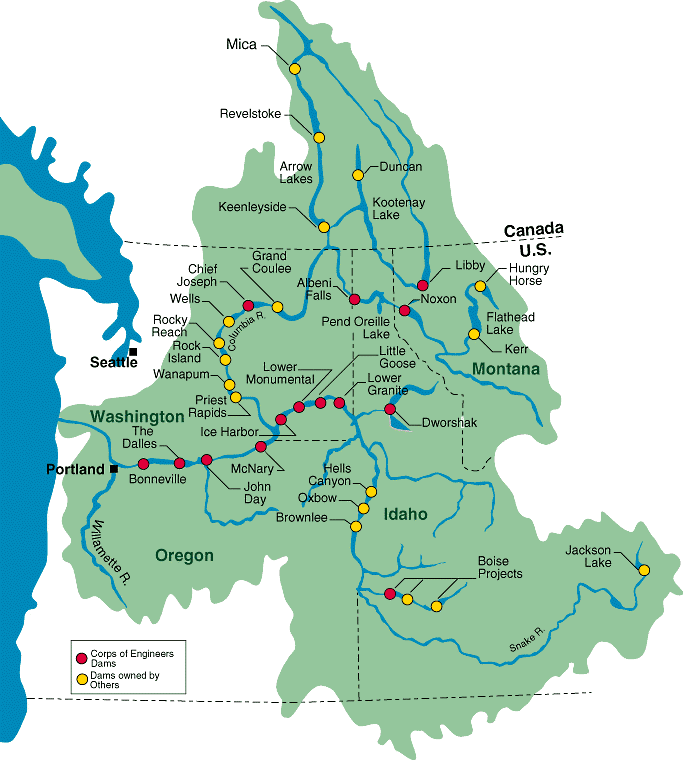
 Here is information from Howard Garret of the Orca Network regarding action being taken against a proposed conservation plan for salmon in the northwest U.S.'s Columbia Basin (where the Columbia and Snake River end at the Pacific coast of Oregon and Washington). Apparently, the plan contradicts existing science regarding the impact of a decline on salmon on the resident orca population.
"On October 29, salmon advocates asked a federal judge to reject the Obama Administration’s 2010 Plan for Columbia Basin salmon and steelhead. This includes chinook salmon that are essential nutrition for our Southern Resident Killer Whales. Today, three facts are clear. One, our orca are often very hungry. Two, they historically dined regularly on Columbia Basin chinook – especially in the lean months of March and April. Three, by failing endangered salmon, the 2010 Plan will also fail our endangered orcas.
 The endangered Southern Resident orca community declined over 20% a decade ago and still teeters on the brink of extinction. Multiple studies tell us why: inadequate runs of Chinook salmon. For thousands of years this unique and cohesive orca clan has survived almost entirely on king salmon, especially those returning to the Columbia basin during winter and spring. In the past few decades those Chinook runs have dwindled to a small percentage of their former numbers. NOAA (National Oceanic and Atmospheric Administration) notes that 'Perhaps the single greatest change in food availability for resident killer whales since the late1800s has been the decline of salmon in the Columbia River basin' (p. 95).
We expected more from NOAA and the Obama administration when they released their Columbia Basin salmon plan as required by the Endangered Species Act. On inauguration day, we were told that good science would trump biased economics and DC politics, and that the process would be transparent. Instead we got a repeat of the corrupt Bush plan and secrecy rather than honesty, despite fierce criticism of that status quo plan from the American Fisheries Society, a wide range of independent biologists, and NOAA’s own scientists.
Regarding orcas specifically, NOAA also fails to explain the huge discrepancy between their 2010 Columbia Basin salmon plan and their 2009 California salmon plan. The CA plan says hatchery fish are no substitute for wild salmon, that orcas need viable wild salmon runs, and there are far too few today. The Columbia plan inexplicably says that hatchery fish are a reliable replacement for wild salmon, and suggests that there are plenty of salmon for orca survival. Despite repeated requests to NOAA to address and resolve this inconsistency, none has been offered.
 There is no doubt in the scientific community about the ecological connection between Columbia/Snake salmon and our much-loved orcas. Canada’s DFO found '…that [orca] survival rates are strongly correlated with the availability of their principal prey species, chinook salmon.' A study concluded that 'Chinook salmon, a relatively rare species, was by far the most frequent prey item.' Winter field studies have also found Southern Resident orcas near the mouth the Columbia River eating salmon headed upriver. UW’s Center for Conservation Biology conducted a multi-year orca study of hormones found in fecal material and concluded that: 'Thus far, the hormone data most strongly supports the reduced prey hypothesis' and that 'For now, it seems clear that mitigation efforts to increase number and quality of available prey to Southern resident killer whales will be an important first step towards assuring SRKW recovery.'
Let’s hope that the judge buries this deceptive plan in early 2011, and brings the federal government and the people of the Northwest together to craft a legal, science-based plan that serves our salmon, our communities, and our orcas.
For more information, please visit: Save Our Wild Salmon and the Orca Network."
 Orcas, or if you prefer, killer whales - are one of the most distinctive cetaceans in the world. Though often associated with cold water regions, these intelligent and highly social predators are actually found in all the oceans. But probably nothing personifies the classic image of the orca as the pods of orcas that frequent the waters in Puget Sound in the northeastern Pacific Ocean - tall dorsal fins cutting through the blue water or whales fully breaching from frigid waters with picturesque forest shoreline backdrops.
But something ominous is taking place in this northern wilderness: the whales are slowly disappearing. There are several theories being studied that could explain the whales decline. But whether it's one cause or a combination, it all springs from one source: mankind.
Outdoor adventure writer Thayer Walker has written a very interesting article for the online Sierra Club Magazine about the decline of these orcas, known by researchers as the "Southern Residents." I had the opportunity to work with Thayer before and he is a gifted writer with a terrific appreciation for our natural resources, from geography to biology.
Thayer writes about the dedicated work of Ken Balcomb, who formed the Center for Whale Research and has been studying the orcas of San Juan Island in the Puget Sound for over 30 years. Balcomb has documented the gradual decline of the number of whales in the area, impacted in the '60s and '70s by the demand for orcas for aquariums and amusement parks. But what appears to be happening now points to possible poisoning from pollution and, perhaps in equal or greater measure, the decline of the whales primary food source - chinook salmon.
Changes in the salmon population, from either overfishing or man-made interference or damage to the salmon's fresh water breeding grounds, have either pushed the orca pods to search for new hunting grounds or, as unfortunately suspected, doomed the whales to starvation. Orcas are known for their highly complex social structures; whales will stay within a pod for life and will stake out territories that are often not easily abandoned.
 But also pollution plays a critical role in this threatening scenario. Much like the chemicals that can accumulate in sharks and dolphins, the blubber in orcas can retain a variety of pollutants that would not necessarily harm the whale (unless absorbed in great quantities) as long as the whale remains vibrant and well-fed. However, when food is scarce the orca will begin to burn some of its fat, thereby releasing stored pollutants into its system which weakens the immune system and the overall health of the whale deteriorates.
The demand for fresh-caught salmon combined with development in the area - including dam building, forest-clearing, and urban growth - are all contributing to the decline of one of the oceans' most magnificent hunters, one that has cruised these frigid waters for eons but is now faced with a threat for which its cunning and intelligence provides no defense.
 Kudos to Thayer for "Empty Sound", a great story. To read the entire article in the Sierra Magazine, click here.
 The Pacific Fishery Management Council recently banned the commercial catching of chinook salmon off the coast of California and much of Oregon. This is the second year in a row that the ban was instituted in response to record low numbers of chinook salmon counted in the Sacramento-San Joaquin River system - a primary spawning area for the salmon.
 In years past, the number of salmon was around 250,000, with a one-time recorded high of 800,000. In 2008, only 66,286 were counted returning to the river to spawn. While any commercial fishing would have a detrimental effect on the remaining population as they return to the open ocean, the root cause of the problem apparently lies in the conditions of the rivers themselves.
Subject to water pollution and water reduction (siphoning off water to quench the large thirst of agricultural regions in California), in addition to reduced food sources from a warmer Pacific and less robust breeding with wild versus hatchery raised salmon - all have impacted the population which is expected to increase slightly in the fall but still be far below the council's recommended minimum goal of 122,000.
Approximately 2,200 fisherman have been put out of work and received federal disaster aid because of the ban but, perhaps surprisingly, many support the ban as the only way to insure the long-term future of the salmon population. Their primary concern is California water policy that seems to be favoring agriculture at the expense of critical salmon spawning grounds.
 In the United States, the Pacific Coast commercial fishing fleet has been steadily declining for years due to regulations, declining fish populations, and the continuing growth of aquafarming. This adjustment to economic reality has recently experienced an unexpected spike downward for those fishermen who take primarily salmon and crab.
Due to a record low in the number of returning chinook salmon to spawn, the federal government canceled the entire Pacific Coast salmon season. And there is the possibility that next year's season could also be called off. This forced fishermen to count on the harvest of dungeness crab to make up for the losses.
 But lo and behold, the dungeness crab season is turning out to be one of the lowest on record. Scientists attribute it to a cyclical nature to crab populations - the cycle is approaching the bottom of a natural ebb and flow - but is compounded by excess fishing and ocean conditions which have disrupted the marine food chain. This year's catch is expected to be less than 25% of what was taken 4 years ago. The laws of supply and demand would dictate that fisherman could demand more per pound for this limited catch, but unfortunately the nation's current economic crisis has reduced demand to below regular market prices. Taken all together, many fishermen expect to be pushed out of business.
Commercial fishing is unfortunately learning the hard way as to the ultimate wisdom of depleting marine resources without having a sensible plan in place to maintain fish stocks. We have a long history of commercial fishing ports drying up and becoming virtual ghost towns through short-sighted thinking. But this new chain of events is an unfortunate nail in the coffin for a declining industry. It also serves as a warning as to what may lie ahead.
 Here is information from Howard Garret of the Orca Network regarding action being taken against a proposed conservation plan for salmon in the northwest U.S.'s Columbia Basin (where the Columbia and Snake River end at the Pacific coast of Oregon and Washington). Apparently, the plan contradicts existing science regarding the impact of a decline on salmon on the resident orca population.
 The endangered Southern Resident orca community declined over 20% a decade ago and still teeters on the brink of extinction. Multiple studies tell us why: inadequate runs of Chinook salmon. For thousands of years this unique and cohesive orca clan has survived almost entirely on king salmon, especially those returning to the Columbia basin during winter and spring. In the past few decades those Chinook runs have dwindled to a small percentage of their former numbers. NOAA (National Oceanic and Atmospheric Administration) notes that 'Perhaps the single greatest change in food availability for resident killer whales since the late1800s has been the decline of salmon in the Columbia River basin' (p. 95).
  There is no doubt in the scientific community about the ecological connection between Columbia/Snake salmon and our much-loved orcas. Canada’s DFO found '…that [orca] survival rates are strongly correlated with the availability of their principal prey species, chinook salmon.' A study concluded that 'Chinook salmon, a relatively rare species, was by far the most frequent prey item.' Winter field studies have also found Southern Resident orcas near the mouth the Columbia River eating salmon headed upriver. UW’s Center for Conservation Biology conducted a multi-year orca study of hormones found in fecal material and concluded that: 'Thus far, the hormone data most strongly supports the reduced prey hypothesis' and that 'For now, it seems clear that mitigation efforts to increase number and quality of available prey to Southern resident killer whales will be an important first step towards assuring SRKW recovery.'


