Showing posts with label orcas. Show all posts

Friday, October 29, 2010

Orcas and Salmon: organizations take aim at U.S. plan that could impact Washington/Oregon whales

Here is information from Howard Garret of the Orca Network regarding action being taken against a proposed conservation plan for salmon in the northwest U.S.'s Columbia Basin (where the Columbia and Snake River end at the Pacific coast of Oregon and Washington). Apparently, the plan contradicts existing science regarding the impact of a decline on salmon on the resident orca population.

"On October 29, salmon advocates asked a federal judge to reject the Obama Administration’s 2010 Plan for Columbia Basin salmon and steelhead. This includes chinook salmon that are essential nutrition for our Southern Resident Killer Whales. Today, three facts are clear. One, our orca are often very hungry. Two, they historically dined regularly on Columbia Basin chinook – especially in the lean months of March and April. Three, by failing endangered salmon, the 2010 Plan will also fail our endangered orcas.
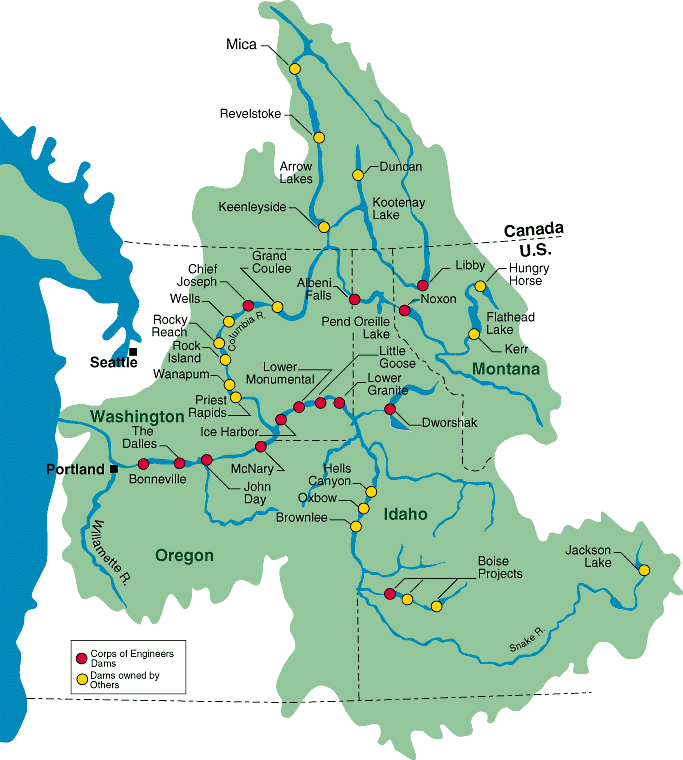
The endangered Southern Resident orca community declined over 20% a decade ago and still teeters on the brink of extinction. Multiple studies tell us why: inadequate runs of Chinook salmon. For thousands of years this unique and cohesive orca clan has survived almost entirely on king salmon, especially those returning to the Columbia basin during winter and spring. In the past few decades those Chinook runs have dwindled to a small percentage of their former numbers. NOAA (National Oceanic and Atmospheric Administration) notes that 'Perhaps the single greatest change in food availability for resident killer whales since the late1800s has been the decline of salmon in the Columbia River basin' (p. 95).

We expected more from NOAA and the Obama administration when they released their Columbia Basin salmon plan as required by the Endangered Species Act. On inauguration day, we were told that good science would trump biased economics and DC politics, and that the process would be transparent. Instead we got a repeat of the corrupt Bush plan and secrecy rather than honesty, despite fierce criticism of that status quo plan from the American Fisheries Society, a wide range of independent biologists, and NOAA’s own scientists.


Regarding orcas specifically, NOAA also fails to explain the huge discrepancy between their 2010 Columbia Basin salmon plan and their 2009 California salmon plan. The CA plan says hatchery fish are no substitute for wild salmon, that orcas need viable wild salmon runs, and there are far too few today. The Columbia plan inexplicably says that hatchery fish are a reliable replacement for wild salmon, and suggests that there are plenty of salmon for orca survival. Despite repeated requests to NOAA to address and resolve this inconsistency, none has been offered.


There is no doubt in the scientific community about the ecological connection between Columbia/Snake salmon and our much-loved orcas. Canada’s DFO found '…that [orca] survival rates are strongly correlated with the availability of their principal prey species, chinook salmon.' A study concluded that 'Chinook salmon, a relatively rare species, was by far the most frequent prey item.' Winter field studies have also found Southern Resident orcas near the mouth the Columbia River eating salmon headed upriver. UW’s Center for Conservation Biology conducted a multi-year orca study of hormones found in fecal material and concluded that: 'Thus far, the hormone data most strongly supports the reduced prey hypothesis' and that 'For now, it seems clear that mitigation efforts to increase number and quality of available prey to Southern resident killer whales will be an important first step towards assuring SRKW recovery.'

Let’s hope that the judge buries this deceptive plan in early 2011, and brings the federal government and the people of the Northwest together to craft a legal, science-based plan that serves our salmon, our communities, and our orcas.

For more information, please visit: Save Our Wild Salmon and the Orca Network."

Wednesday, May 5, 2010

Marine Mammals Postscript: act today in advance of Congressional hearing

As a follow up to yesterday's post about captive marine mammals (whales and dolphins), the folks behind the documentary film The Cove have sent out an email apprising people about a Congressional subcommittee hearing regarding marine mammals on display.

At question is the National Marine Fisheries Service's permitting process that requires that education and conservation - not entertainment - be the foundation for issuing permits to hold marine mammals in captivity. Whether this is being adhered to or that it requires some tightening is one of the key issues. As you can expect, there will be significant pressure from organizations like SeaWorld to keep things as status quo.

There is a public comment period that expires Friday, May 7th. If you would like to send a brief and respectful comment, you can email subcommittee clerk Katherine Romans at katherine.romans@mail.house.gov

Here is some suggested copy from David Phillips of the "The Cove" - Save the Dolphins group:

"There is no educational value to the whale and dolphin shows prominent within public display facilities today. The ethics of riding atop these wild animals, feeding and forcing interactions with them, goes against everything we are taught about them – in fact, those types of encounters are illegal in the wild. And yet, public display facilities promote this bad behavior and even encourage it for paying customers.

This is a manipulation of fact for the benefit of financial enterprise.


I strongly urge you to establish strong oversight of the education programs for public display facilities of marine mammals. Under the current law they have become performance spectacles that serve our amusement rather than our education."


Here is the body of the email I sent:

"Dear Ms. Romans:

Please forward or print this email for the appropriate subcommittee members.

Since the very first marine mammals (ie: whales and dolphins) were placed in captivity, scientists have learned more about the intelligence and complex social and physiological behaviors of theses animals – behaviors that are in direct conflict with the conditions that these animals are subjected to today while in captivity. While scientific study and educational outreach to better understand mankind’s impact globally on marine mammal populations is a valid activity, the priority today of marine amusement parks like SeaWorld is entertainment and an economic return on investment. We have evolved beyond the need for animals jumping through flaming hoops or balancing balls on their noses to appreciate their important roles within a marine ecosystem.

While some might advocate the release of all captive marine mammals, I side with those advocates, like Jean-Michel Cousteau, who feel that these animals have, unfortunately, been in captivity long enough (some since birth) that the prospects for successful introduction into the open oceans is doubtful. However, I support a ban on seeing any other marine mammals taken captive in the future accept for quantified and justified scientific research solely and not for public display.

Congress needs to initiate agencies to exercise greater oversight in granting permits for the capture and display of whales and dolphins. Large pelagic animals – animals that roam the open seas – should not be subjected to the confines of tanks and forced to perform tricks for our amusement. We are a better species than that. And these species deserve better treatment than that.

Respectfully,

Richard Theiss
RTSea Productions"

Yes, I know. I run a bit long. So, pick and choose as you like, but send something to Ms. Romans today.

Read USA Today article about upcoming Congressional hearing.

Tuesday, May 4, 2010

Captive Marine Mammals: old news or still simmering?

Since the tragic death of an orca trainer at Florida's Sea World, there has been an ongoing discussion among many ocean conservationists regarding whether orcas, dolphins, and other marine mammals should remain in captivity.

David Shiffman of the blog, Country Fried Science, weighed in on the subject with an interview with Jean-Michel Cousteau, founder of the Ocean Futures Society. David has received many comments to his post, ranging from the release of all orcas currently in captivity, condemnation of aquatic amusement parks like Sea World, condemnations of all aquariums, to defending such institutions on their educational value.

You can read the posting and decide (or comment) for yourself. I have included my comment to David's posting:

"As a shark advocate/ocean conservationist, filmmaker, and someone who was a dive volunteer at a major aquarium for many years, my position is:
* I agree with Jean-Michel that releasing all currently captive orcas and dolphins would not be feasible or broadly successful.

* I have seen firsthand the educational value of aquariums and zoos, but there is a definite difference between an aquarium and an aquatic amusement park.

* Some species – like whales, dolphins, and other pelagics – are typically not suitable animals for captivity because their open-water lifestyle can not be replicated. (White and whale sharks and tuna are current exceptions but they require enormous enclosures and it’s new – the jury is still out as to their long-term health.)
* Seeing these animals in the wild or with today’s multimedia technology (surround theaters, 3D, etc.) can be suitable alternatives.

* I too was inspired to love the sea as a child watching Bubbles, the pilot whale, do tricks at Marineland. But that’s not the only way to develop an appreciation for marine life and I would like to think that we are, albeit slowly, finding better ways to promote conservation.

* I would hope that the days of “educating” people by seeing dolphins jump through hoops of fire and seals balancing a ball on their nose is coming to a close. But because of the economic incentives at hand, I’m afraid it will be a slow evolution.
"

There is no easy answer to this issue, with powerful economic forces at work and the potential for some form of enlightenment at hand, but I believe it's time for a change in approach to presenting these open-water animals to the public.

What do you think?

Thursday, February 25, 2010

Orcas In Capitivity: a tragedy brings up the need for a new rationale

I would have to have blinders on to not notice the news reporting and online commentary surrounding the tragic death of Dawn Brancheau , the Sea World orca trainer, due to the actions of one of the Florida sea park's resident whales. There are 25 articles alone on UnderwaterTimes.com and the social media sites have been buzzing with opinions, mostly recognizing the double tragedy in both the human loss and the life and future fate of the whale involved.

There will be much to be sorted out: what precisely happened, was there something that triggered the whale's actions, what were the whales recent behavior patterns? And on and on. After all is said and done regarding the details of the incident, the fundamental question of whether such animals should be kept on display, I'm sure, will be debated for months to come.

On the one hand, the marine animal acts are a founding cornerstone of the organization. Regardless of how the Sea World parks have expanded over the decades, the killer whale show is their lasting iconic image - and that represents a considerable financial investment and commitment. I know that can sound a bit crass, but it's a reminder that Sea World will likely defend the practice.

And if we look at it historically, from its earliest beginnings, dolphin and whale shows served a
purpose in enlightening the public to the intelligence ("intelligence" in human terms) of these animals at a time when interest in their survival was growing - right at the outset of the anti-whaling movement. Even today, the basic rationale for zoo/aquarium captivity is still offered with a degree of merit, as long as the animals are provided with a relatively comfortable and natural-like environment.

But on the other hand, as it has been pointed out in the news by several experts including members of the Cousteau family, it has only been in captivity that orcas have harmed humans. We are being reminded that these marine mammals normally roam the wide open seas and exhibit highly social behavior patterns within their pods. What happens to their mental health when they are confined in concrete tanks and separated from normal animal interpersonal relationships has been continually debated from day one.

It is tragically ironic that what we may have ultimately learned in initially keeping these large marine mammals in captivity is that it may be best not to do it at all. We have warmed and enlightened people to the beauty of seals, dolphins, and whales with balancing balls and hoops of fire - now, perhaps it is time to better enlighten people as to how these animals live in the wild and what we should do to insure their survival in the surroundings that nature intended.

Tuesday, January 5, 2010

Orcas of the Puget Sound: article looks at vanishing whale pods

Orcas, or if you prefer, killer whales - are one of the most distinctive cetaceans in the world. Though often associated with cold water regions, these intelligent and highly social predators are actually found in all the oceans. But probably nothing personifies the classic image of the orca as the pods of orcas that frequent the waters in Puget Sound in the northeastern Pacific Ocean - tall dorsal fins cutting through the blue water or whales fully breaching from frigid waters with picturesque forest shoreline backdrops.

But something ominous is taking place in this northern wilderness: the whales are slowly disappearing. There are several theories being studied that could explain the whales decline. But whether it's one cause or a combination, it all springs from one source: mankind.

Outdoor adventure writer Thayer Walker has written a very interesting article for the online Sierra Club Magazine about the decline of these orcas, known by researchers as the "Southern Residents." I had the opportunity to work with Thayer before and he is a gifted writer with a terrific appreciation for our natural resources, from geography to biology.

Thayer writes about the dedicated work of Ken Balcomb, who formed the Center for Whale Research and has been studying the orcas of San Juan Island in the Puget Sound for over 30 years. Balcomb has documented the gradual decline of the number of whales in the area, impacted in the '60s and '70s by the demand for orcas for aquariums and amusement parks. But what appears to be happening now points to possible poisoning from pollution and, perhaps in equal or greater measure, the decline of the whales primary food source - chinook salmon.

Changes in the salmon population, from either overfishing or man-made interference or damage to the salmon's fresh water breeding grounds, have either pushed the orca pods to search for new hunting grounds or, as unfortunately suspected, doomed the whales to starvation. Orcas are known for their highly complex social structures; whales will stay within a pod for life and will stake out territories that are often not easily abandoned.

But also pollution plays a critical role in this threatening scenario. Much like the chemicals that can accumulate in sharks and dolphins, the blubber in orcas can retain a variety of pollutants that would not necessarily harm the whale (unless absorbed in great quantities) as long as the whale remains vibrant and well-fed. However, when food is scarce the orca will begin to burn some of its fat, thereby releasing stored pollutants into its system which weakens the immune system and the overall health of the whale deteriorates.

The demand for fresh-caught salmon combined with development in the area - including dam building, forest-clearing, and urban growth - are all contributing to the decline of one of the oceans' most magnificent hunters, one that has cruised these frigid waters for eons but is now faced with a threat for which its cunning and intelligence provides no defense.

Kudos to Thayer for "Empty Sound", a great story. To read the entire article in the Sierra Magazine, click here.

Wednesday, October 28, 2009

Orcas: new studies show changes in killer whales

When discussions of Arctic or Antarctic species come up, they often focus on polar bears, penguins, and walruses - all animals worthy of our concern and whose populations are at risk from changes in their environment due to climate change, pollution, or oil drilling development.

Orcas - or, if you like, Killer Whales - are also being impacted by environmental changes, some good and some not so good.

In a report from Canadian scientists, there is evidence that orcas are able to manage changes in their ocean environment by moving more northward, extending their uppermost boundaries in the Arctic Circle. This is made possible by the reduction of sea ice, particularly in the summer months.

Orcas typically cruise the thinner edges of the Arctic ice but avoid the thicker ice where access to the surface for breathing would be more limited. The scientists reviewed data of orca sightings dating back centuries and saw a definite increase since 1900 in the Arctic region, including into the Hudson Bay, that coincides with the recorded reduction of the Arctic sea ice. It remains to be seen whether this will disrupt the marine ecosystem as the orcas possibly begin to prey more and more on northern Arctic species like bowhead whales, belugas, and narwhals.

In another study, orcas were cited as a probable cause for the decline of sea otters, seals, and sea lions along southwest Alaska over a period of several decades. Not to completely blame the orcas, the study points to a cause for this change in the orcas' diet as the result of industrialized whaling. Whaling decimated whale populations and deprived orcas of an important food source. Hence the shift to other marine mammals as prey.

Orcas are extremely social animals, living in family units or pods, that can exist for many years, complete with elaborate and close social hierarchies. External stressors (ie: changes in their environment and/or food source) that produced changes in populations have been cited in a recent report as a possible cause for changes in the social structure of orcas in Canadian/U.S. waters. It opens the door for more study as to the impact of habitat change on the social order and survivability of this highly social marine mammal.

And lastly, according to a scientific report, the population of orcas that inhabit the Antarctic's Ross Sea, has apparently been decreasing both in terms of frequency (when observed) and in numbers and the primary culprit is, once again, commercial overfishing. In this case, the overfishing of the Antarctic Toothfish, a primary food source for this particular orca population. Whether the orcas have declined or are moving on to better hunting grounds has yet to be determined. But it is another example of the struggle between man and nature over available marine resources. And if the ocean's animals keep losing - from the smallest feeder fish to large predators like orcas - then ultimately we lose.