Showing posts with label scuba diving. Show all posts

Sunday, August 28, 2011

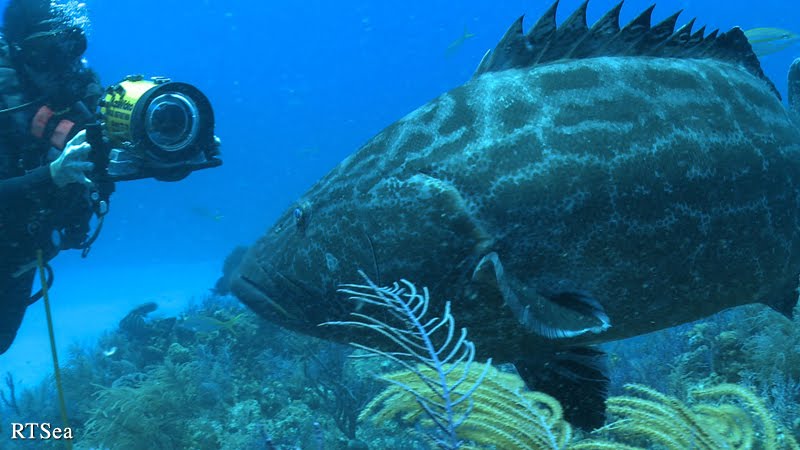
Filmmaker's Journal: one of Bahama's groupers comes to play

The last time I was in the Bahamas this past spring, I was there aboard Blue Iguana Charters' MV Kate to film sharks . . . again. Not that I ever get tired filming those incredible animals but, after all, variety is the spice of life, right? That's what makes the Bahama's so much fun and Capt. Scotty Gray knows how to pack a lot into one trip: sharks, wreck diving, dolphins, and beautiful reefs.


Here's a quick video that briefly shows some of the shark fun the Bahamas are famous for, but also highlights a great encounter that crew member Rob MacDonald and I had with a large grouper. Groupers are popular gamefish with Florida sportfishermen and that's unfortunate because their numbers have declined - just when the marine ecosystem needs them most. With the explosion in the past few years in the number of lionfish, a beautiful but voracious reef fish that is an invasive species to the Caribbean, the grouper is one of only a few large predators that can potentially help keep the lionfish population in check, if only the grouper population itself was in better shape.


The grouper that visited Rob and I was initially interested in our bait crate, which contained some slabs of fish to attract Caribbean reef sharks. The reef sharks knew who was boss and you'll see one dart out of the grouper's way, as groupers are not afraid to butt heads with a shark if need be. With no easy meal available, the grouper proceeded to act like a cat weaving between our legs looking for a good petting. Actually more of a back scratching, as these large fish will attract small, pesky parasites and the grouper won't shy away from an opportunity to dislodge some of these hitchhikers.


The grouper continued to pass back and forth between the two of us for a good five to ten minutes. Then Rob pulled out a hunk of fish from the crate as a thank you to the grouper for spending time with us. And with that, it was on its way.


It's always a treat when you have the chance to safely interact with large animals. Sometimes it takes a few minutes to size up the animal's behavior to ensure, as best you can, that you won't be harassed or bitten. There's always that thought: "I wonder if this big fella is looking for some payback for all the relatives we humans have pulled out of the sea?"


Sunday, June 5, 2011

Filmmaker's Journal: SCUBA Show indicates renewed life in ocean sport

Yesterday, I spent the day and evening at the SCUBA Show in Long Beach, California. This is one of the, if not the, largest recreational scuba diving show open to the public. For me, as a diver and filmmaker, it's an opportunity to see the latest toys, bells, and whistles to carry under water. It's also an opportunity to meet up with many of the friends and leaders in the scuba diving industry, from manufacturers to island resorts.

Judging by what I saw yesterday (the show runs for the entire June 4-5 weekend), business is beginning to pick up. The dive travel industry, like so many other disposable income activities, took a severe hit with the economic downturn. But with the slight (albeit very slight) improvement that has occurred with the economy - and, probably more importantly, with consumers finally saying enough is enough with all this doom and gloom - there appeared to be more people willing to get back in the water, whether it's locally or via some exotic destination.

It could be an advantageous time for the consumer as we are not out of the woods yet, economically speaking, so retailers and resorts are offering some pretty amazing deals. Not to get totally off-subject, but it seems that while many look to Wall Street or the government or industry to turn things around, we must not forget the mindset of the consumer. Throughout this entire financial crisis, everyone pulled back on spending as well they should. And as much as Wall Street's ups and downs are often motivated by attitude, so it is with the general public. So there is some evidence that we are beginning to peek out of our shells and show some willingness toward prudent consumption that will hopefully stimulate the economy. What I saw at the SCUBA Show was, perhaps, a small indication.

However, back to scuba diving. Two noticeable trends I saw was a greater proliferation of simple, easy-to-use underwater camera systems that deliver some terrific results. Many of the cameras provide both still and video (although they're a long ways from broadcast-quality video, so I don't think my skills will be put out to pasture just yet). But there are some amazing systems that can provide divers with wonderful digital memories of their dive travel experiences.

Also, technical diving is making more inroads into the general diver populace, particularly in the area of closed circuit rebreathers. These are diving systems that recirculate and clean the carbon dioxide from your exhalation, adding in the required amount of pure oxygen to replenish what you consumed. What this provides then is extended depth and bottom time - and no
bubbles. For photographers and vidoeographers, the advantage to having no bubbles can be very significant. With surrounding sealife, the standard scuba system is quite a disturbing noise-maker, with bubbles being exhaled into the water with each breath. Rebreathers often allow divers to get much closer to fish and other sealife, with provides for better photo and video opportunities.

Closed circuit rebreathers are much more technically advanced than the standard scuba unit (and if not properly maintained or operated, can be quite dangerous), but as with any technology, advances have been made to make them safe enough that they are now making more inroads into the general diving community and not just restricted to advance technical divers or professional photographers and filmmakers.

The SCUBA Show in Long Beach will be concluding today, just in time for a change to summer weather - which will bring out the local California divers. If you are a certified scuba diver anywhere in the world, I would suggest dusting off your gear, checking in with your local scuba dive store retailer, and getting back in the water. If you are a non-diver considering the sport, now may be a great time to get started. It's a great way to remind yourself as to what makes the oceans so special and why we need to dedicate our energies to preserving them for generations of divers to come.

Monday, March 7, 2011

Filmmaker's Journal: the yin-yang of the sea

Last night, my long-standing dive buddy, Budd Riker, and I did a night dive at Shaw's Cove in Laguna Beach, California. Budd had been out to this dive location two nights before and was amazed at the range of sea life he came across. One round stingray after another, large mantis shrimp strolling across the sandy bottom, and surprisingly good visibility considering the flat sandy bottom of the cove.

But as can, frustratingly, often be the case when you come across an unusual occurrence, Budd had not brought his digital SLR camera that particular evening. And so here we were on Sunday, hoping for a repeat performance. On this dive, I kept my video camera at home (not much fun dragging a 70-pound rig through the surf) and was going to act as Budd's scout, using my underwater light to search for subjects to shoot.

We arrived as the sun was beginning to set. Some dark clouds were rolling in, but that did not matter to us (whereas in a daytime dive, losing the sun's ambient light would be a bit disappointing). Shaw's Cove has a large rocky reef structure to the right side that extends perhaps 200 yards out. At the moment, the tide had much of the top of the reef exposed and so Budd and I spent some time combing over the tidepools and recalling some of the many dives we had made here.

Budd has done literally thousands of dives at Shaw's Cove both for pleasure and when he used to be a scuba diving instructor. I had not done anywhere near as many, but still knew many of the contours of Shaw's Cove's reef structure. We talked of the "Crack" and grotto that runs across the reef and how much fun it was to investigate its many passages - always mindful of the occasional swell that could rush through, sending you on a roller coaster ride and slamming you against the rocks or a wall of spiny sea urchins if your timing was all wrong. Ah, the good times.

And so we waited for night to fall, reminiscing over past dives and noting how so many formations seem unchanged after all these many years. There seemed to be a consistency to the sea, a familiarity at Shaw's Cove that said, no matter what the ocean has been through, there are some things in life that never change. Now, with a black sky above, Budd and I suited up and waded through the very calm surf. Budd was ready for images of the many creatures he saw just a few nights ago. And I was ready to be his hunting dog, pointing them out to him.

That was the plan. The ocean saw things a bit differently that night.

We swam on the surface for a while before descending to 18 feet to begin our dive. Shaw's Cove has a wide sandy plain that drops off slowly, so one can travel quite a ways and still be relatively shallow - at several hundred yards off shore you can still only be at 25 to 30 feet in depth. We moved out slowly, keeping our eyes alert for those multitudes of stingrays and mantis shrimp.

But tonight was to be a very different night. First, I saw, through the beam of my light, what first appeared to be a considerable amount of particles floating in the water; sea grass pulverized by wave action perhaps. "Well, this loss of visibility won't make Budd very happy," I thought. Then I realized that the particles had an interesting dancing movement to them. Plankton! A multitude of minute larvae gyrating about - I felt like I was trapped in a goldfish bowl full of sea monkeys.

Next up on the changing menu was the contour of the sandy sea bottom itself. What was very flat a few nights ago, with small ripples in the sand, was now transformed into deeper ridges and valleys of sand, exposing purple sand dollars and allowing small ghost shrimp or juvenile halibut or flounder to find safe haven in the deep sandy depressions. Only a couple of small rays appeared and there were no mantis shrimp to be seen. Several types of crabs were scuttling about, raising their claws in defiance of the bright lights that gazed down upon them. We came upon two small crabs in the throes of conjugal bliss and while Budd snapped photos, the male slowly dug into the sand, holding fast to his mate and taking her with him. Oh, no. Hounded by the paparazzi once again.

And so what was familiar was now different. The sea can be a very fickle place. Some things can appear unchanged, dependable - this will last for eternity. And yet, below the waves, there is a very fragile and constantly evolving world taking place. Set into motion by waves, currents, temperatures, and the bio-rhythms of thousands of sea creatures, the yin-yang of the sea is susceptible to all of these influences and those imposed upon it by man.

Eventually feeling the chill of the early Spring water temperature, Budd and I surfaced and made our way back to shore. More surprised than disappointed that his hoped-for quarry had eluded him, Budd still had some great pictures from our dive. As we stepped out of the surf, we found that the dark clouds from earlier in the evening had now turned into a light rain; another reminder that our world is ever-changing.

It was a good dive and a reminder that we can never take the ocean and all that live within it for granted.

See more at Budd Riker Photography and Budd's blog.

Friday, June 11, 2010

Jacques-Yves Cousteau: centennial celebrates a pioneer

On this centennial of the birth of Jacques-Yves Cousteau, I'd like to reprint an article from today's National Geographic News, that pretty much says it all as to why this man was such a seminal figure in bringing oceanography and ocean conservation to the masses:

Jacques Cousteau Centennial: What He Did, Why He Matters
Marking Cousteau's hundredth anniversary—five successes, one great legacy.
By Ker Than for National Geographic News
Published June 11, 2010


The late Jacques Cousteau's hundredth birthday is inspiring headlines and, Friday morning, a Google doodle—perhaps the ultimate Internet accolade.

Why is the ocean explorer such a legend? Here are five good reasons.

1. Jacques Cousteau pioneered scuba gear.

With his iconic red beanie and famed ship Calypso, the French marine explorer, inventor, filmmaker, and conservationist sailed the world for much of the late 20th century, educating millions about the Earth's oceans and its inhabitants—and inspiring their protection.

Little of it would have been possible without scuba gear, which Cousteau pioneered when in World War II he, along with engineer Emile Gagnan, co-created the Aqua-Lung, a twin-hose underwater breathing apparatus.

With the Aqua-Lung, Cousteau and his crew were able to explore and film parts of the ocean depths that had never been seen before.

(Get the inside story of Jacques Cousteau's adventures with the National Geographic Society.)

2. Cousteau's underwater documentaries brought a new world to viewers.

Jacques Cousteau's pioneering underwater documentaries—including the Oscar-winning films The Silent World, The Golden Fish, and World Without Sun—"had a storyline," said Clark Lee Merriam, a spokesperson for the Cousteau Society.

"Their message was 'Come with me and look at this wonderful thing and see how it acts and behaves,'" said Merriam, who had worked with Cousteau for nearly 20 years before the explorer died in 1997.

"It was a deep and complete introduction for the general public to the undersea world."

(Download wallpaper of Jacques Cousteau underwater and deploying a "diving saucer.")

3. Cousteau pioneered underwater base camps.

Jacques Cousteau and his team created the first underwater habitat for humans: Conshelf I, which begat Conshelf II and III. The habitats could house working oceanauts for weeks at a time.

"He was ahead of even the United States Navy, which was doing the same thing in proving people could live and operate underwater for extended periods of time," Merriam said.

Broadly speaking, "it's technology that industry uses now, because it's a lot less expensive to keep someone down there working than to have them down there for 30 minutes and come back up," she said.

4. Cousteau helped restrict commercial whaling.

Cousteau "intervened personally with heads of state and helped get the numbers necessary for the [International Whaling] Commission to pass the moratorium" on commercial whaling in 1986, Merriam said.

The moratorium remains in place today, though some countries still hunt whales in the name of scientific research.

5. Cousteau helped stop underwater dumping of nuclear waste.

Cousteau organized a popular campaign against a French-government plan to dump nuclear waste into the Mediterranean Sea in 1960—and took his fight straight to the president of the republic.

Cousteau "faced off with General de Gualle in France about the proposed dumping, and he continued to oppose nuclear power," Merriam said.

"He acknowledged that it was a clean power source and full of possibilities but felt that—as long as we're dealing with waste that we don't know how to handle—we should not pursue it."

In the end, the train carrying the waste turned back after women and children staged a sit-in on the tracks.

Jacques Cousteau, Late-Blooming Environmentalist

Cousteau's films and books could make the ocean seem like a boundless and bountiful wonderland, bursting with life and blessedly isolated. But the captain himself knew better.

"He thought it was a conceit of humans that the oceans are endless and that we can keep turning to them as an unending source of food and anything else we wanted," Merriam said.

By all accounts, Cousteau was not always an ardent environmentalist, nor was he always particularly sensitive to the creatures he was filming in the beginning. "He started out as a spear fisherman and a world explorer, not a guardian," Merriam said.

Merriam points to a "horrific" scene in The Silent World in which the Calypso collides with a baby sperm whale. Believing the animal to be near death, the crew shoots the animal—then also shoots sharks that attack the now dead whale.

Merriam remembers when The Silent World was remastered about 20 years ago. "Everyone in the organization said we have to cut out these really ugly scenes that show all of this bad behavior."

But "Cousteau said, 'No, no we're not. It was true, and it shows how far we've come and how dreadful humans can be if we don't curtail ourselves,'" she recalled.

Jacques Cousteau Legacy Endures

If Cousteau were alive today, he would probably be saddened by how little has been done to address pollution, overfishing, and other threats to the world's oceans, said Bill Eichbaum, vice president of marine and Arctic policy at World Wildlife Fund (WWF), an international conservation organization.

(Read why Jacques Cousteau would be "heartbroken" at our seas today—commentary by his son Jean-Michel.)

But Cousteau wouldn't be discouraged, said Eichbaum, who worked with Cousteau briefly during the 1970s.

"He would be passionately concerned, and I think, even more articulate and aggressive in urging governments, companies, and individuals to protect the environment," he said.

For her part, the Cousteau Society's Merriam said, "We miss the visionary, and we're glad he set us on the path that we're trying to keep on."
Monday, February 22, 2010

Filmmaker's Journal: the sea reminds you who is the boss

For the past few days I was offline, as Scott Cassell, founder of the Undersea Voyager Project, and I were in Bodega Bay, California trying to film Humboldt squid.

Notice I said "trying."

It was one of those experiences where you get reminded as to who is the real boss on the water. On Day One, we left Bodega Bay and traveled 35 miles offshore to an area known as Cordell Bank. Sportfishermen having been pulling up large numbers of squid from this area. The sky was overcast but the seas were fairly calm. Northern California waters are not always gin clear and after days of prior rain, the water, combined with the threatening sky, was making filming impossible (Humboldt squid run from video lights, so there had to be sufficient ambient light for us to film).

Day Two and we're hit with another ocean gremlin: an engine malfunction with the boat. Remember, boats are holes in the water, lined with wood, into which you pour vast amounts of money.

So, a lot was riding on Day Three, the last day of shooting. The sky was cooperating with cottony patches of clouds patterned across vast expanses of bright blue. And a gentle breeze was slowly picking up as the morning temperatures increased.

Oh, oh. The morning breeze. It can be a bad indicator of what's taking place offshore.

And so we set out - a crew of six including Scott and myself. As we cleared the jetty that keeps Bodega Bay's inner waters nice and calm, we see an ocean horizon that looks like broken glass - meaning large swells and wind chop. The worse roller coaster you can think of is about to seem tame.

For several hours we plowed forward. Tom Loomis at the wheel did a terrific job handling the boat. But when we reached our destination, it was easy to see that diving was out of the question. With the boat riding in 10+ foot swells and white caps peaking from two different directions, getting in the water would have been challenging but not impossible. Getting out would have been flat-out dangerous. And there was the planned potential of a decompression dive; but with heaving seas, trying to hang on to a line at the proper decompression depth was out of the question. Scott scrubbed the dive and we headed back, both a bit disappointed and relieved.

The ocean is one of the earth's most powerful forces and must never be underestimated. Whether it's explorers looking to peer into it's depths with cameras at hand, fishermen plundering its bounty of sealife, or factories spewing pollutants into its delicate ecosystem - the ocean has its ways to remind us who is the boss; who will do what it takes to protect itself, adjusting itself to survive; and who will be around in some form or another long after we have managed to eliminate ourselves from the game.

Monday, November 9, 2009

Filmmaker's Journal: mackeral form massive aquatic highways

This past weekend, me and my good friend, photographer Budd Riker, went over to Catalina Island, off of Southern California, for a couple of dives. I needed to test out a new lens for my Amphibicam EX3 underwater housing - a great housing for a great video camera (the Sony PMW-EX3). I'm fortunate to have one of the few housings currently available in the U.S.

To make it quick and easy, Budd and I took the fast Catalina Express boat to the main island city of Avalon to dive at the popular Underwater Park at the city's famous Casino Point. With the park being a great place to conduct scuba diving classes, the sea wall at the point is typically lined with dive bags and assorted gear - and this day was no exception. It was crawling with divers.

But the Underwater Park seems to handle the diver pressure pretty well. It's a protected zone; you can't remove anything from the water except trash, no souvenir empty shells, no rocks, nothing. And because there is no fishing or hunting of any kind, it becomes a sort of refuge for many fish. Large calico bass will hang out in the flowing kelp and California sheephead will cruise by, seemingly aware that they are free from harm within the park's borders.

From above, we noticed that the visibility looked clear and promising, with a slight current moving through and bending the long stalks of kelp over to one side. Upon entering the water, our surface observation was confirmed: exceptional visibility for this location with an almost uncharacteristic blue tint to the water.

As we settled to the bottom, we were greeted by a large school of young mackeral. When they amass along the rocky shoreline, it's quite a sight to see. You have probably seen pictures or films of large schools of anchovies or other fish, congregating in immense balls. Well, for these mackeral, they instead form an undulating mass that weaves its way around the rocks and kelp like some elaborate network of aquatic highways with various underpasses, overpasses, turnoffs and junctions. Thousands of fish emulating California rush hour traffic (and when the current picks up, they come to a stop, hovering - just like our daily battle with gridlock!).

It's believed that a fish's lateral line - a sensory organ along the length of its body that can detect changes in water pressure - is what enables fish to maintain spacing and move en masse in schools. Each fish, when swimming, produces a pressure wave that the surrounding fish can sense and with that a collective sense of order and movement is established.

The mackeral continued to entertain us and gave us plenty of subject matter to film or photograph. They would double back, seeming to enjoy the security of the Underwater Park and only occasionally spreading out in large circles to give a possible hungry Calico Bass a wide berth, or darting about suddenly when a sea lion would make a quick pass.

Just an overall great day at one of Southern California's ocean treasures: a simple, little underwater oasis, able to withstand man's curiosity. Hopefully, with each new diver that completes their training at Catalina's Underwater Park, a conscientious ocean conservationist is born.

Video clips of schooling mackeral will be up soon in RTSea's stock footage library.

Saturday, August 15, 2009

Giant Kelp: preserving a cornerstone of California's marine ecosystem

A dive buddy who I have not seen in many years was vacationing with his family on the west coast and we hooked up this past Thursday to do a day of diving at Anacapa Island, the southernmost island in the northern Channel Islands group. He had not been diving the Channel Islands since he moved back east some 14 years ago, so it was going to be interesting to see and hear his reaction to being back in the ol' stomping grounds where we had logged many a dive.

Conditions were typical for this time of year: a little overcast and the water was it's usual summer green tinge with about 20 feet of visibility. Not bad since we were going to be spending most of our time cruising through the kelp.

Giant kelp forms one of the foundations of California marine ecosystems, providing food and shelter for a variety of animals from its root-like holdfast structure right up to the canopy that is formed when the stalks reach the surface and continue to grow. At its healthiest, a field of giant kelp is like a dark mountain forest; gliding between the stalks is like flying past aged timbers.

California's kelp forests have suffered over the years and the fields are not quite as robust as they were, say, 20 years ago. With kelp being very sensitive to warmer temperatures (actually dying off when the water exceeds 70 degrees for any sustained period of time), the forests have felt the impact of seasonal El Nino warm water currents, warmer summers and milder winters, and pollution. Also, in some areas, with the reduction of certain gamefish that feed on urchins (which in turn feed on kelp), the increase in the population of these spiny echinoderms has wiped out entire kelp beds. There are several organizations and ongoing projects involved in replanting kelp and, since kelp can grow amazingly fast given the right conditions, these replanting efforts hold great promise in bringing back kelp forests to their former glory as an oasis that attracts sealife of all kinds. But it all hinges on those "right conditions" of clean water and cooler temperatures.

There may not be much that we can do about seasonal temperature changes like El Nino currents (although some scientists believe that the duration or severity of these weather patterns are effected by the overall climate change issue), but we can certainly do something about the impacts of pollution, CO2 emissions, and over-fishing that contribute to less than ideal conditions for the kelp forests.

My dive buddy and his daughter had a great time diving; he fell right back into his old ways of peeking under every rock outcropping or crevice with his light, to see what might be making a home there. We had one large and curious male sheephead follow us around, and on another dive we were playfully bombarded by sea lions from a local rookery. But he did notice a lack of fish and other sea critters he remembered from past dives. And I couldn't argue with him: things have changed.

Let's hope that we - the consumers, the businessmen, and the decision-makers - take ocean conservation seriously and act swiftly and responsively. Otherwise, we will be left with only memories and maybe what we find on display in aquariums and museums.

Tuesday, March 10, 2009

Coral Reefs: usage zones to be set up in Nusa Pineda

Always nice to hear about measures being taken to protect coral reefs. Some people feel we have bigger fish to fry when it comes to marine issues, but coral reefs are extremely important to the health of the entire oceanic ecosystem. Just because you may not have coral reefs in your backyard, doesn't mean they have less impact.

The Coral Reef Alliance reported that in Nusa Pineda, near Bali, steps are being taken to establish various coral reef zones that will determine their use for activities like fishing and diving or snorkeling. It was recognized that the health of the reef impacts its value as a tourist destination. And the dollars brought in by tourism can offset or compensate loses in fishing or other aquatic farming activities.

Marthen Welly of The Nature Conservancy-Coral Triangle Center explained that what was proposed was three zones, namely the central, the utilization and the marine tourism zones, in the marine conservation area plan.

The central zone will cover areas that have the most breathtaking underwater view and are often visited by the world-famous Mola-mola fish and other types of marine life, including the manta ray and sperm whale. The utilization zone comprises offshore areas that can be utilized for seaweed farming and fishing; while the marine tourism zone, which also includes the central zone, can be used for water sports activities.

“Separating the zones is important because the activities in the islets are not well-managed now. People can plant seaweed anywhere, or fish in the snorkeling and diving spots,” Marthen said.

Balancing the interests of local fishermen or farmers with the economic benefits of tourism is an important goal for many tropical reef locales. Let's hope that was has been proposed for Nusa Pineda is successful and acts as an example to others. (Read article from The Jakarta Post.)

Monday, February 16, 2009

Scuba Divers: be part of the solution, or you're part of the problem

As a scuba diver for some 25 years or so, I have had the opportunity to dive in a variety of locales and have, over the years, seen some significant changes in various aspects of marine ecosystems - from reef degradation to reduced fishlife to encroaching pollution and man-made debris. So, I have tried to be a thoughtful diver while also trying to enlighten as many people as possible to the many issues challenging our world's oceans, often through my volunteer diving at aquariums and through public speaking.

Scuba divers can serve as ambassadors for marine conservation as they have a unique perspective having been active participants, shall we say. They have seen the ocean's beauty firsthand; they have witnessed its complexities - these are not alien experiences, gleamed from a book or dreamt about. And because we divers take benefit from what the ocean has to offer us then we have a responsibility to do what we can to preserve it. We must not choose to cede it all to the activists or the decision-makers, assuming that they can carry the ball without our help.

When I am speaking to groups about marine conservation, often in regards to shark conservation, I occasionally run across a diver or two who are a bit worn out from all the eco-preaching. They just want to dive and leave the "save the seas" stuff to someone else. Sorry, but that ship has sailed. We all must chip in and do our part: know what's going on, get involved in some capacity if only just to let your voice be known; otherwise you risk being as selfish a consumer of the seas as those who have been labeled as the worst of abusers.

After all, what are you there for? To see vibrant sealife, healthy reefs, lush kelp forests? Or do you just want to experience the cool features on the latest dive computer or fashionable wet suit? To those divers who are committed to preserving the earth's oceans - many, many thanks. To the uncommitted - be part of the solution, not part of the problem.

Thursday, August 7, 2008

Aquariums: a bridge between science and the public

I am preparing to leave for the Aquarium of the Pacific in Long Beach, CA, as I have done for nearly every Thursday for the past 8 years. As a volunteer Dive Team Leader, I have had the pleasure of helping the Aquarium with exhibit feeding, cleaning and, most importantly, conducting underwater presentations to the kids and adults alike.

If you have an aquarium nearby, check out what opportunities they may have available. As non-profits, they rely heavily on volunteers - so if you have some free time, it can be a very worthwhile and gratifying experience.

People are drawn to aquariums for a variety of reasons. They may be coming to make fish faces at the seals, recoil in fear and fascination at the sharks, or simply looking for a way to let the kids blow off some pent up energy. Whatever their motivation, it's a great opportunity to get across some important marine conservation info in a more relaxed atmosphere. Aquariums can serve as effective liaisons between the scientific community and the general public. So, if you have one nearby, give it your support.