Showing posts with label sharks. Show all posts

Saturday, October 29, 2011

Shark Conservation: CNN reports on sharks, their supporters and going shark-free

As a follow up to my Thursday post on CNN's report on ocean plastic pollution to air this Sunday, October 30th at 5pm and 8pm, also in the same program will be a segment on sharks and shark conservation efforts: Sharks: from predators to prey.

The segment will cover many of the issues that shark advocates have been promoting for several years, but it always bears repeating. Overfishing from commercial shark fishing operations, the high demand in Asian countries for shark products - particularly shark fins - and the critical role that sharks play as apex predators in maintaining a healthy and well-balanced marine ecosystem. These are the facts. Over-sensationalism, like rampaging sharks on the attack for humans at any opportunity, is what fuels misconceptions and provides fodder for a media looking for a quick headline. However, for the most part, CNN has done a pretty responsible job in putting forth the truth about sharks and the threats they face. So, kudos to the folks in Atlanta.

The shark segment on CNN this Sunday also looks at the Shark Free Marinas Initiative (SFMI) and its director, marine biologist Luke Tipple. Luke is a good friend and I've had the opportunity to capture him on film many times both above and below the waves, diving in open water with white sharks, tigers, and others, or talking about sharks and the Shark Free Marinas Initiative.

With location services set up by SharkDivers.com, CNN spent time with Luke in the Grand Bahamas where SFMI has a foothold with one of the island's most popular marinas catering to sportfishermen. Compared to commercial operations, the number of sharks taken by recreational sportfishermen is much smaller but at this stage of the game, the loss of any shark is a blow to the species' population.
Recreational shark fishing tournaments are still being held each year and draw considerable worldwide criticism from conservation groups like The Humane Society - which supports SFMI. But when sportfishermen either opt for catch-and-release of sharks or choose not to catch them altogether, it can have an impact on an influential segment of the ocean-going public that can spread.

Here's a video preview of the CNN news report:


CNN's Sharks: from predator to prey airs Sunday, Oct. 30th at 5pm & 8pm PST (8 & 11pm EST) on CNN.
Learn about the Shark Free Marinas Initiative.

Saturday, October 8, 2011

A Week for Sharks: CA shark fin ban is now law, Australia concerned over shark diving

It's been a week for sharks, particularly in California. Governor Jerry Brown signed AB 376 into law which bans the trade and possession of shark fins in California. This was a critical piece in a mosaic of shark fin distribution in the northern Pacific ocean.

As reported by COARE (Center for Oceanic Awareness Research and Education), "California's ban complements bans in place in Hawaii, Washington, and Oregon, effectively shutting the west coast of the United States to fin traders. It is estimated that the United States is responsible for 70% of the world's fin imports outside of Asia. With a staggering 85% of those U.S.-bound fins passing through California, AB 376 will have a tremendous impact on shark conservation."

Now we must watch for where the next distribution hubs will appear - there's too much at stake financially for some of these shark fin distributors to simply throw in the towel. And there is also the concern over illegal activities.

But the tide does seem to be turning and other nations are considering tighter regulations or out right bans on shark products. My personal concern is that, for some of the general public, sharks have become the cause d'jour and while there are some hard working advocates who, I am sure, will keep the fires burning for more conservation and regulation, I worry that the general public might tire of the cause - in today's Information Age, attention spans can dry up in the blink of an eye - and without public support, commercial shark fishing lobbyists and business representatives will jump on the opportunity to sway politicians in their favor. Only time will tell.

"The world has been watching and waiting. With similar efforts underway in parts of Canada, and with a ban proposed in China, California's efforts hopefully will ripple into many other places," said COARE.

However, one avenue whereby people can appreciate sharks up close in the wild may soon be curtailed or at least limited. Australia is one of three or four primary locations in the world where people can cage dive to view great white sharks. But Australia's ABC News reports that there
are new findings that white sharks are staying in close to coastal areas, where they are often baited for the shark diving operators, and anecdotal reports of an increased number of shark/surfer encounters has some saying that the number of operators should be halved from four to two and that the number of days in which they can chum for sharks should also be reduced. (Click image to view video.)

There have been studies, both in Australia and Hawaii, that show that the sharks' response to chumming over a given period is a transitory behavior and does not equate into 1.) a significant change in the shark's normal feeding behavior and 2.) that the sharks do not equate the boat-supplied food with humans. However, some thought should be given to the fact that in Australia, they are currently chumming for white sharks as much as 270 days a year - double that of just a few years ago.

On a personal note, today I am leaving for San Diego, California to embark on my seventeenth trip to Isla Guadalupe off the coast of Baja, Mexico, compliments of Shark Diver. Isla Guadalupe is one of the world's premier sites for viewing great white sharks. A population migrates to the
island in the fall months and though Mexican government regulations have greatly scaled back any baiting of the sharks, there are still plenty of encounters to keep the cage-bound divers thrilled and satisfied. I will be accompanying my friend and photojournalist, Budd Riker on his inaugural trip as he takes notes and pictures for a future photo magazine article.

While some zealous Mexican conservation groups have expressed concern that the shark diving operators at Isla Guadalupe have, over the years, disrupted the normal behavior of these sharks; in the seven years that I have been coming to the island I have yet to see any evidence or reason for concern. When the sharks were more vigorously chummed and baited in the past, the sum total of what they consumed was a mere drop in the bucket compared to the normal requirements for their diet which, for adults, consists of primarily seals and sea lions. And as the sharks would inhabit the waters around Isla Guadalupe for just three to four months, it is reasonable to assume that they didn't spend the next eight months wasting away, waiting for when they would return to Mexican waters for some leftover fish parts.

So, I will be heading out in just a few minutes and will post a follow up when I get back in a few days. In the meantime, shark advocates, no time to rest on our California legislation laurels. There's still more work to be done.

Sunday, October 2, 2011

PETA on Sharks: hotly contested billboard reinforces stereotypes

During the course of writing this blog over the past couple of years, many of my readers have come to appreciate a certain civility and thoughtfulness that I try to bring to my work. It's obvious by the subjects that I discuss that I am pro-conservation, pro-ocean, and pro-shark to name a few, but I rarely engage in rude put-downs or coarse language.

But PETA's latest billboard campaign truly tests my resolve. By showing a human leg dangling from the jaws of a white shark with the headline, "Payback is hell," this pro-animal rights group sets public awareness and support back a few notches by reinforcing stereotypes of the shark as mindless killers. Or actually, not mindless at all but cunning and vengeful - right out of a bad Jaws sequel.

Though PETA (People for the Ethical Treatment of Animals) spouts some obligatory quotes about humans being the ultimate predator, not sharks; their real message is an anti-meat, pro-vegan position - which is fine to express but not at the expense of one of the very animals you claim to be protecting.

They may have thought, "Oh, people will get it. It's just a shark, just a picture." Well, in a world where American presidents have their nationality and their patriotism questioned, where climate change is expected to be cured by prayer, and where fallen soldiers are called "faggots" and said to have deserved to die; it's not all that hard to imagine many people viewing the PETA billboard and confirming to themselves that sharks are selecting humans for attack and therefore do not need our protection or concern - proof that the only good shark is a dead shark.

There have been many who have been assaulting PETA for this billboard and their stated rationale (as a follow up advertisement to a recent shark bite incident near the Gulf of Mexico.)

"With the recent shark attack in the news, we thought that it was a good time to bring this discussion up that will hopefully save lives, both human and animals," PETA Campaign Manager Ashley Byrne told The Huffington Post. "Sharks are not the most dangerous predators on Earth, we are. Americans alone kill billions of animals for food every year, including fish. And while sharks are natural carnivores, people can choose what they eat."

That's right, Ms. Byrne, sharks are natural predators, feeding on a wide range of animals which, in turn, helps to maintain a healthy and balanced ecosystem. And with their continuing loss through commercial fishing, that balance is quickly being thrown out of whack. But the 50 injuries and 5 fatalities that people experience from sharks on average each year are not the result of a concerted campaign of retaliation, as your billboard moronically implies.

Shame on you. If you feel you need to promote such a ludicrous statement to support your cause, then I suggest you rethink your cause. People can be fooled with misleading images and headlines and so, because of that, it is incumbent on anyone who believes a cause to be righteous to deal in truth always.

"Payback is hell." It's stupid, lame, misleading and basically just a flat out lie. And it's serious, not intended as humor or satire - so we will take it as the serious statement that it is and I along with many of my conservation and shark advocate colleagues will choose not to ignore but to soundly repudiate it.


If you wish to express your views to PETA regarding the billboard, you may fill-out an online message form at the Peta website. Click here.

Sunday, September 25, 2011

Hong Kong Shark Foundation: taking shark advocacy to the streets of Hong Kong

Shark conservation has grown over the years with some quantifiable progress in the form of legislation, regulations, and defined sanctuaries. There has been some improvement in advocacy and general public awareness. But there has also has been time, energy, and needed funds wasted over perhaps well-intended feel good campaigns whose results did nothing to move the needle in the direction of improved conservation.

Actually, that can probably be said of all conservation movements and so it is incumbent upon all of us who are interested in conservation issues to study the players and make sure that our efforts and support are directed to those groups who can bring about real change.

Regarding the issue of market demand in Asian countries for shark fin products, I was encouraged to see this small news item by the Associated Foreign Press and picked up far to the west in the Oman Daily Observer: a "plankmob" in the streets of of downtown Hong Kong to protest shark fins and shark fin soup. The event was planned for today, Sunday, by the Hong Kong Shark Foundation - an organization dedicated to conserving sharks and situated in the midst of one of the major trade centers for shark products.

"Supporters of the Hong Kong Shark Foundation march along a street to raise awareness for sharks killed each year for their fins, in Hong Kong yesterday. According to studies of the shark fin market up to 73 million sharks are killed each year, primarily for their fins used in shark fin soup. A bowl of shark fin soup can cost 100 USD, with a single fin being worth more than 1,300 USD."

Read about the Hong Kong Shark Foundation.

Monday, September 5, 2011

Demon Fish: an A to Z look at sharks and the world surrounding them

The summer has come to a close, Discovery's Shark Week has passed, sightings and shark incidents have once again brought out the "Summer of the Shark" hyperbole and so now, as the seas begin to calm, it's time for some well-written, intellectual discourse on the subject.

If one is interested in learning about sharks, there are quite a few books available - just do a search on your favorite online book retailer and you'll find a vast selection to choose from. There are many stunning picture or coffee table editions from which you can appreciate the variety of sharks. And there are some good informational books, many of which churn over the same information - almost a common vocabulary or library of factoids. It can be interesting to review some of these books based on when they were written; there's much that we keep learning about sharks so the science is continually being re-written.

However, I don't believe there has been a definitive volume that looks at not only the well-worn facts, but also the culture, the history of man's relationship with the shark and how that effects our past, present, and future attitudes - all of which play a hand in the shark's future and our own. No such volume existed until now, with the publication of Demon Fish by Juliet Eilperin (Pantheon Books).

Subtiltled Travels Through the Hidden World of Sharks, Demon Fish represents several years of study by Ms. Eilperin into both the role of sharks within the marine ecosystem and the role it has played in our society. The reader experiences the big picture and the many players involved, from scientists to sportfishermen to commercial shark traders to island natives to worldwide conservation groups. Eilperin weaves these all together into a tapestry of interconnectivity: many may fear the shark, but it has been a part of our lives for centuries.

As the national environmental reporter for The Washington Post, Eilperin is the consummate journalist, digging deep for details, providing the background to put people, places, and events into context. For some who may be looking for a wild adventure yarn, there may be more detail here than desired. But to take a pass would be a shame. Demon Fish takes you into the world of the shark and the world that surrounds it. If sharks are to succeed as a species, we must understand and appreciate both worlds.

Eilperin writes of the many scientists, shark advocates, and conservation organizations that are working to both understand and protect sharks. Names like Peter Klimley, Robert Hueter, Neil Hammerschlag, Mahmood Shivjii, Barbara Block, South Africa's Alison Kock, and many others from around the world - some well-known in shark advocate circles, some perhaps not - all have their work highlighted to show what we are learning about sharks, how important they are to maintaining a healthy ocean, and why many of them are become scientist-activists as they reaffirm that the greater predator - the true villain in this aquatic play - is humankind itself.

However, even though Eilperin's pro-shark position is clear throughout the book, as a seasoned impartial journalist she also delves into the lives and the minds of those who we might think of as some of the shark's greatest adversaries: commercial shark traders, sport or commercial fishermen, and indifferent or anti-shark cultural attitudes particularly in Asia. This is an aspect of Demon Fish that I believe sets it apart from all the rest. From avid shark hunters like "Mark the Shark" Quartiano, who runs shark fishing charters out of Florida, to Yip Chiu Sung, a major Hong Kong trader in shark products, Eilperin's interviews and observations paint a complete portrait of those who view sharks as a commodity or as a demon that needs to be destroyed.

For many of today's fervent shark advocates, having this backstory view of those who they would prefer to condemn is critically important as more and more legislation and regulations are being proposed worldwide to protect sharks. In today's political world, the success of such policies will depend on strategies that can convince and win over those who view sharks more in economic rather than ecological terms. Demon Fish allows us to know our enemies just as much as our heroes.

Centuries ago, many cultures respected and even worshiped sharks - some island nations still do. But for the most part there was a cultural shift that propagated fear and ignorance. It has taken time, but those attitudes are now wreaking havoc on an entire species. Meticulously written, Juliet Eilperin's Demon Fish comes closest to being the alpha/omega examination on how we got to where we are today, what's being done, and what may lie ahead.

Sunday, August 28, 2011

Filmmaker's Journal: one of Bahama's groupers comes to play

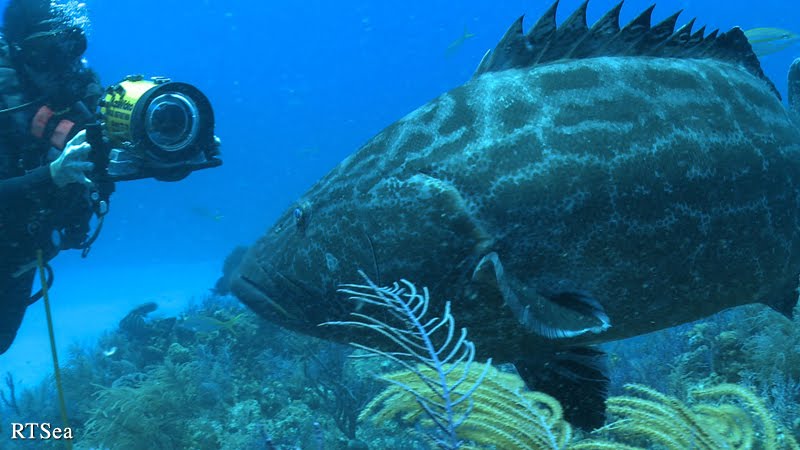
The last time I was in the Bahamas this past spring, I was there aboard Blue Iguana Charters' MV Kate to film sharks . . . again. Not that I ever get tired filming those incredible animals but, after all, variety is the spice of life, right? That's what makes the Bahama's so much fun and Capt. Scotty Gray knows how to pack a lot into one trip: sharks, wreck diving, dolphins, and beautiful reefs.


Here's a quick video that briefly shows some of the shark fun the Bahamas are famous for, but also highlights a great encounter that crew member Rob MacDonald and I had with a large grouper. Groupers are popular gamefish with Florida sportfishermen and that's unfortunate because their numbers have declined - just when the marine ecosystem needs them most. With the explosion in the past few years in the number of lionfish, a beautiful but voracious reef fish that is an invasive species to the Caribbean, the grouper is one of only a few large predators that can potentially help keep the lionfish population in check, if only the grouper population itself was in better shape.


The grouper that visited Rob and I was initially interested in our bait crate, which contained some slabs of fish to attract Caribbean reef sharks. The reef sharks knew who was boss and you'll see one dart out of the grouper's way, as groupers are not afraid to butt heads with a shark if need be. With no easy meal available, the grouper proceeded to act like a cat weaving between our legs looking for a good petting. Actually more of a back scratching, as these large fish will attract small, pesky parasites and the grouper won't shy away from an opportunity to dislodge some of these hitchhikers.


The grouper continued to pass back and forth between the two of us for a good five to ten minutes. Then Rob pulled out a hunk of fish from the crate as a thank you to the grouper for spending time with us. And with that, it was on its way.


It's always a treat when you have the chance to safely interact with large animals. Sometimes it takes a few minutes to size up the animal's behavior to ensure, as best you can, that you won't be harassed or bitten. There's always that thought: "I wonder if this big fella is looking for some payback for all the relatives we humans have pulled out of the sea?"


Wednesday, August 24, 2011

Catching a Shark: marine laboratory to study effects of catch-and-release

In many parts of the world sportfishing is big business - there's no getting around it. And so whether you support or are opposed to the practice, it will probably be around for some time as long as there is money to made.


But it can be altered to provide for greater survivability of the fish through catch-and-release techniques. For conservationists, this isn't an ideal solution by any means. Dr. Sylvia Earle refers to catch-and-release as "torture and release" and to a large extant she has a point. Catching any fish by hook causes stress on the animal. After all, it was swimming and feeding one moment and the next, it's in complete survival mode fighting against some unknown force and slowly reaching a state of total exhaustion before being momentarily manhandled and then once again free to roam.


So, one way to look at catch-and-release is that it is an incremental step, one foot forward towards a greater awareness as to the sustainability and current dwindling populations of, in particular, large species like billfish and sharks. That is part of the philosophy behind the Shark Free Marinas Initiative (SFMI), supported by The Humane Society of America and the Guy Harvey Ocean Foundation. This organization gets sportfishing marinas to sign up to be "shark free" - meaning no sharks can be brought in to their docks for weighing, trophy photos, butchering, anything. No sharks, period.


Sure, to us hard core conservationists it would be great if all sportfishermen abandoned their rods and reels but, again, the economic underpinnings make it very unlikely that state or local governments will pass the required regulations that would effectively outlaw the sport. In California, legislation to prohibit the possession, trade, and distribution of shark fins is preparing for a final vote in the state senate. Those who oppose the legislation, AB 376, are pushing their campaign for a series of crippling amendments not because they hate sharks or love shark finning but because they see considerable dollars and many jobs that will be lost with its passage. Those who favor the legislation must carefully hone their argument and keep in mind that it is not the moral position or even the environmental position that will likely sway the politicians; it will be the economic rationale. And in today's current economic mess, any talk of lost revenue or jobs will certainly catch a politician's interest.


But I digress. . .


If we concede that catch-and-release is at least one step back from the brink of destruction of a fish, it's not an unreasonable question to ask just how much of a step it really is. Just how traumatic is catch-and-release on, say, a shark? Are there any long-term effects? Does the animal survive for the moment but die some days or even weeks later due to complications?


To better understand the lingering effects of catch-and-release techniques, Florida's Mote Marine Laboratory will begin a one-year study on sharks, aided by a $192 million grant from the National Oceanic and Atmospheric Administration (NOAA). Assisted by the Florida Aquarium's Center for Conservation and the Massachusetts Division of Marine Fisheries, the study will enlist the services of several sportfishing charter boats and will focus primarily on the blacktip shark, a popular species for shark fishermen because it is known to put up a good fight and often leap out of the water - some of the same criteria that make billfish like marlin popular among sportfishermen.


“For the first time, we’ll take a magnifying glass to sharks’ behavior after release — for instance, we’ll look at how strongly they’re swimming after capture and whether they’re rolling or listing,” said project leader Dr. Nick Whitney, a staff scientist in Mote’s Center for Shark Research. “These measurements go way beyond ‘dead or alive.’ The vast majority of sharks may survive, but it’s important to know if their recovery time varies with different kinds of fishing gear. Our technique will yield new, hard data comparing standard J-hooks with circle hooks, which are designed to be safer for sharks.”


Scientists will enlist the use of accelerometers - the same little electrical devices that sense movement in your smartphone or handheld video game player - along with small data recorders to record the movements of a shark as it is released following a catch-and-release episode. Every flick of the shark's tail or tilt of its dorsal fin will be recorded. The devices will fall off the shark after a period of time and will be retrieved and analyzed to determine the shark's behavior after being caught. By understanding what is being inflicted upon the shark, either temporary or long-lasting, wildlife management agencies can then better determine how best to minimize the effects through regulations and the use of various types of fishing gear.


“The goal will be for the charter captains to use the same practices and gear that Florida anglers normally would, so we can compare the two hooks in a real-world setting and look at how they perform in relation to shark survival and behavior,” Whitney said.


Personally, I choose not to fish. As a diver I stopped spearfishing or taking game like lobster or abalone many, many years ago. But I realize that sportfishing is a popular activity and thriving business in areas like Florida, and that overly-efficient, but indiscriminate, commercial fishing probably poses a much greater threat to overall survivability for many ocean species. So, if I want to sit down with a sportfisherman and have a go at changing his mindset and his hobby, having the scientific facts, as this Mote Marine Laboratory study hopes to obtain, will give me some heft to my argument - and could just maybe help prevent me from getting punched in the nose.

Sunday, August 14, 2011

Post-Shark Week Progress: basking shark taggings and California's AB376

Now that Discovery Channel's Shark Week has concluded and the entertainment frenzy that surrounds it has subsided, we all can get back to some serious-minded steps in research and policy to advance our understanding and conservation of these animals. Here are a couple of recent developments:


Basking Shark Tagging in Monterey

With each new study on sharks, scientists learn a little more about the wonderful world of sharks, but there are still some species that are shrouded in mystery. Take the basking shark, the second largest of all sharks, next to the whale shark, and one not to be feared as it is a filter feeder like baleen whales.


Preferring cold water, the basking shark has been studied in the North Atlantic, but limited studies have taken place in the Pacific. The Pelagic Shark Research Foundation has just started a more detailed tagging program in and around Monterey Bay, CA, utilizing satellite tracking tags that have been successfully used on other species like great white sharks. To date, only basic number/color identification tags have been used. With the use of an archival satellite tag - which can store various position, depth, and speed data for later retrieval via satellite - the foundation can accumulate more detailed and accurate data as to the movements of basking sharks.


Sean Van Sommeran, founder and director of the Pelagic Shark Research Foundation, describes the basking shark as
"elusive" and, as they are recognized as threatened, are considered "commercially extinct."


Working in conjunction with Stanford University and the National Oceanic and Atmospheric Administration (NOAA), Van Sommeran's foundation has tagged one sub-adult basking shark at around 15 to 16 feet in length and plans to tag more.


California's AB376 Anti-Shark Fin Bill Advances

This Monday, California's Assembly Bill 376, which prohibits sale, possession, and distribution of shark fins - much like legislation already passed in Hawaii, Oregon, and Washington - will take the next step on its way to a final vote. The bill will go before the Senate Appropriations Committee and for many of the bill's supporters, the big issue here is whether there will be any amendments tacked on to the legislation that will weaken it and provide loopholes for commercial operations to continue.


You can support and participate in various efforts being staged by a variety of shark advocate groups - Sea Stewards, based in San Francisco, is planning a bus ride tomorrow to Sacramento to make a physical presence in support of AB376. However, one of the best ways to make your voice heard is through direct communication to the members of the committee. Sea Stewards has provided a listing of the members' email addresses and sample email content.


senator.kehoe@sen.ca.gov,

Senator.Alquist@SENATE.CA.GOV,

senator.runner@sen.ca.gov,

senator.price@sen.ca.gov,

senator.walters@sen.ca.gov,

senator.lieu@sen.ca.gov,

senator.alquist@sen.ca.gov,

Senator.Pavley@senate.ca.gov

Dear Senators,

I urge you to vote for AB 376 without amendments. Scientists have testified that the suggested amendment to allow shark fins from domestic fisheries cannot be enforced and will lead to increased fishing pressure on domestic sharks and allow black market fins to enter the market.

Also, the MSC certification of fins is not a viable option. To date there has not been a well managed and sustainable shark fishery. Focused shark fisheries lead to collapse of the population. Sharks are vital for ecosystem health.

For these reasons please support this bill as written.

sincerely,

There are some powerful forces at work in opposition to AB376 that have pulled out all the stops to amend, if not defeat the bill, using accusations of anti-Asian sentiments or lost commercial and state revenue. It's getting down to the wire and the lobbyists will be playing hardball on both sides. Let your sentiments be heard by the elected officials - oddly enough, in this world of ineffectual politics, it can make a difference.


Read about basking shark tagging in the
Santa Cruz Sentinel.

Read about AB376 and what you can do at SeaStewards.org.


Saturday, July 30, 2011

Man Bites Shark: a rational look at reports of increased shark encounters

For better or worse, this is the shark's time of year. Newspapers, magazines, television programming and news broadcast, and motion pictures - all forms of media jump on the bandwagon to herald the summer of the shark. Nearly one-third of my posts this month, so far, have been about sharks - and I wasn't even making a conscious choice to do so.

Fueling the annual fire this year about sharks - particularly any shark-human interactions - is the fact that there have been more human interactions with sharks. There are a multitude of reasons behind this, depending on the location and the shark species, but complex explanations are not the stuff of quick sound bites and hot-of-the-press headlines. However, without delving into the devilish details then people are left to fall back on simplistic reasons that plug into their primal curiosity mixed with fear of these animals: the number of sharks are growing; and they are out to get us.

And so, at the apex of the annual shark mania (or nadir, depending on your point of view), I present the calm, rational position statement - not from my hand but from The Washington Post's national environmental science write, Juliet Eilperin. Writing for Foreign Policy, Man Bites Shark is an overview of man's interaction with the shark world from the 1500s to today. It examines the reasons why more sharks, ranging from benign whale sharks to great white sharks, have been reported in the past few years, and why shark attacks increased by 25% in 2010.

In many respects, we are two species on a collision course. And the one steering the boat is mankind.

At first glance, sharks -- with their sharp jaws, torpedo-shaped bodies, and unusual sensing abilities -- appear to be bizarre vestiges of a distant past. But they can also tell us a lot about our present and our future. Where sharks appear in big numbers, coral reefs and other marine life around them thrive because they remove weak and sick animals from the system and can keep midlevel predators in check. When they shift their migrations, scientists often detect a shift in ocean temperatures and prey populations. For researchers seeking to create a more efficient electric battery, faster vessels, or a robot that can track oil and chemical spills underwater, sharks' sleek and extraordinarily efficient bodies offer inspiration for design. In countries where their fins end up at the dinner table, economists can generally find rising incomes. The animal humans fear most has become a global commodity, an economic indicator, and environmental harbinger of things to come.

In many ways, the movie character Matt Hooper was right on the money when he said, "All sharks want to do is swim, eat, and make little sharks." That can be said of almost every creature in the sea. It's mankind that has the multiple agendas that put us in touch with sharks, from tourism to fishing to research to storytelling.

In Man Bites Shark, Ms. Eilperin is the objective journalist, putting emotions aside - either pro-shark or anti-shark. Just the facts.

During the 20th century, the increase in shark attacks in Florida -- which leads the world in shark strikes almost every year -- closely tracked both the state's population rise and the number of people going to the beach, according to statistics compiled by the University of Florida's International Shark Attack File. In 1900, Florida's population stood at 530,000, and there was one unprovoked shark strike between 1900 and 1909; by 1950, the state had 2.77 million residents, and attacks that decade totaled 13; by 2000, when the population had soared to nearly 16 million, 256 shark strikes took place over the course of the decade.

Many of us familiar with sharks have heard this argument before: more people equals more shark encounters. Ms. Eilperin adds credibility by giving us the numbers. In addition, she adds balance to sensational reports of a mass schooling of blacktip reef sharks off Palm Beach, Florida; congregating whales sharks off the Yucatan Peninsula; or increased white shark sightings off the California coast.

Noteworthy, Man Bites Shark is not appearing at the check-out counter in People magazine; it's in Foreign Policy and so Ms. Eilperin turns her attention to the environmental and economic disaster we have visited upon the shark and some of the complex diplomatic jockeying that has been taking place amongst nations.

International trade and fishery management meetings have become a series of regional skirmishes. Japan and China have managed to torpedo trade protections at international fishery-management bodies for species ranging from hammerhead to porbeagle sharks, in part through forging alliances with smaller countries such as Grenada, Suriname, and St. Kitts and Nevis. But the United States has continued to press the case, along with both European officials and those from countries such as Palau and the Maldives, both of which have banned shark fishing in their waters.

Cheri McCarty, a foreign affairs specialist in the U.S. National Oceanic and Atmospheric Administration's Office of International Affairs, has spent the last two-and-a-half years negotiating over shark protections in the global arena, and she has gotten used to the weary reactions her presence can provoke. "There are times I'll go to meetings where people say, 'Oh no, not the U.S. pushing sharks again.' But slowly but surely, we have more allies on our side now."

If you are already bitten by the "I love sharks" bug, Man Bite Shark is no cure; it's a rational affirmation of a position that seems to be slowly growing. If you are on the fence and what you have been reading in the news or are about to watch on television this weekend gives you pause, then you should read Man Bites Shark, too. A little common sense between handfuls of popcorn or chewing your nails nervously wouldn't hurt.

Read Man Bites Shark in Foreign Policy.

Monday, July 18, 2011

Shark Week & Conservation: the time of year when hype, reality, and rational voices vie for our attention

It's summertime, August is approaching, and that means it's time for Discovery Channel's Shark Week. This ratings bonanza for Discovery (over 30 million viewers last year) continues to thrill a large segment of the general public while infuriating many pro-shark activists with program titles like Deadliest Waters or Anatomy of a Shark Bite. There's no doubt that Discovery tries to have it both ways by providing a measure of conservation content (they actually did a rather well-balanced piece on shark conservation for Discovery News - see below) combined with programs that pander to the malevolent killer shark stereotypes. Discovery seems to have found a balance that allows them to have their cake while eating their vegetables too.


During this time period, sales of other shark-related films (like my first documentary, Island of the Great White Shark) enjoy a momentary surge; press reports of shark sightings and human-shark interactions increase in frequency; and shark advocates roll their eyes and wring their hands in frustration.

Case in point would be the following promotion for a Shark Week program picked up by outdoor writer Pete Thomas for GrindTV. South African photographer Chris Fallows has made a career filming sharks and is known for his striking images of great white sharks leaping into the air when ambushing prey. He is part of a Shark Week program titled Great White Invasion - Immediately sounds ominous, doesn't it? Chris is attempting to debunk some of the myths regarding the ferociousness of these apex predators by approaching one with a paddleboard.


The shark is curious, no doubt, but appears to realize that the board and its rider are neither prey (a seal or sea lion) nor something to scavenge, like a dead whale carcass. It's in shallow water so it's not going to attack with a powerful lunge from underneath, as is its usual method, so it swims about somewhere between mild curiosity and disinterest (notice the moment in the video when it simply treads water, looking at the board and its rider - probably thinking, What the heck is this?

The risk to Chris Fallows is that, in fact, some sharks like to bump objects to check them out, particularly if they are wondering if it is an inanimate carcass. I have experienced that before firsthand. While I hung over the side of a Zodiac (a sturdy inflatable raft) filming white sharks, a large 15-foot male approached us and then "bumped" the raft a good foot and a half into the air and, with a flick of his powerful tail, proceeded to smack me across the side of the head. Me and the captain got the message and headed back to the main boat, our adrenaline pumping and my left cheek stinging.

However exciting incidents like that may be or whatever heart-racing programs Discovery's Shark Week may have in store for us, the reality of what sharks themselves are experiencing at the hands of man cannot be overlooked. People may not love them - and the fact is, they don't have to - but they do need to respect them and understand their vital role in maintaining a healthy ocean as critically important predators and scavengers.

And it will be the wisdom of rational voices that ultimately gets the job done. In Australia, Mick Dowers, founder of the Anti-Shark Finning Alliance, makes his case on ABC Brisbane radio's Breakfast with Spencer Howson. What better way to start a cat fight than to then bring on a Chinese Australian to comment - let the fight begin, eh?! But, no. Two rational people with their own points of view discuss the issue calmly and you can begin to hear common ground developing.

Click the 612 ABC Brisbane logo to download audio file (mp3).


That's what it will take: rational people talking about a less than rational practice in an attempt to preserve both, a dwindling species and a fading cultural history.

Sunday, July 10, 2011

Shark Conservation Progress: encouraging regional steps; next up - international regulations

Shark conservation has certainly been making some progress over the past couple of years. Several nations have instituted new regulations within their waters regarding commercial shark fishing or the total prohibition of shark fins. Here is a short list of developments:

Bahamas: The Bahamas National Trust, with support from the PEW Environment Group, was able to get substantial citizen support for its declaration of a Bahamas Shark Sanctuary. The sanctuary was created by adding an amendment to the Fisheries Resources Jurisdiction and Conservation Act to prohibit commercial shark fishing along with the sale, importation and export of shark products.

California, USA: Because of it's two large ports in San Francisco and Los Angeles, a considerable amount of shark product trade is done through California. Assembly Bill 376, a ban on import/export of shark fins similar to Hawaii's ban that went into effect last year, has passed the Senate Natural Resources & Water Committee and now moves on to the Senate Appropriations Committee. While facing strong opposition from shark industry-supported groups that claim a racial prejudice, since most of the market for shark products is with Asians, the legislation has also received considerable support from a host of vocal pro-shark groups and celebrities. Though the legislative process is complicated, passage appears to be likely. The biggest concern is whether, in making its way through the political machinations, the legislation remains intact or becomes watered down with exceptions or loopholes.

Honduras: Honduras also established a shark sanctuary in late June. President Porfirio Lobo Sosa signed the sanctuary bill into law, making permanent a 2010 moratorium on commercial fishing for sharks in the 92,665 square miles of Honduras' exclusive economic zone, which covers both its Pacific and Caribbean coasts.

Guam: The Association of Pacific Island Legislatures (APIL) issued a
resolution in June stressing the need for additional actions to protect sharks. The resolution, reached at APIL’s general assembly conference in Palau, states that the association agrees with “protective legislation in Palau, Hawaii, CNMI (Northern Marianas) and Guam.” The member states of APIL are the Northern Marianas, Guam, Palau, Yap, Chuuk, Pohnpei, Kosrae, the Marshall Islands, Kiribati, American Samoa, Nauru and Hawaii. The exclusive economic zones of all APIL member nations total an area larger than the land masses of the continental United States and European Union countries combined.

Washington, USA: Following the lead of Hawaii, the state of Washington passed legislation in May that bans the sale, trade, and distribution of shark fins. The legislation received near unanimous support in the House and 100% backing in the Senate.

Oregon, USA: The state of Oregon is moving forward with legislation to ban the sale and trade of shark fins. Legislation has passed the House and is awaiting hopeful passage in the Senate. As is the case with other US state legislation, it does not affect or eliminate existing legal commercial shark fishing regulations, but focuses on only shark fins.

Asian Markets: Taking aim at the heart of the problem, Asian market demand, a recent poll of 1,000 Hong Kong residents
showed 78 percent of respondents considered it “acceptable” to leave shark fin soup off the menu at events like weddings. In another sign that the topic is getting top-level attention, a deputy of the National People’s Congress in Beijing, Ding Liguo, filed a proposal last month to ban trade in shark fins, according to a report from Xinhua, the state-run news agency. “Only legislation can stop shark fin trading and reduce the killings of sharks,” Mr. Ding said, adding that the mainland, Hong Kong and Taiwan consume 95 percent the world’s fins. There's still a long ways to go in altering Asian market demand, but these are encouraging signs.

The environmental argument for protecting sharks - the disruption of marine ecosystems caused by the loss of top predators like sharks - is having some resonance with various governments. Another motivator is, as is often the case, economics. More and more substantiated reports are coming out showing that a live shark has a much greater long-term value - sometimes in the millions of dollars - than a dead shark with respect to tourism dollars, either through shark ecotourism or simply the maintenance of a healthier reef for swimmers, snorkelers, and divers by the presence of a balanced shark population.

However, as important as these national efforts are, they only impact regional waters or cause shark fin import/export centers to move elsewhere. International waters are still left wide open. While the shark conservation movement has begun to move beyond the early emotional position regarding the barbarity of shark finning to focus more on the environmental and economic impacts, thereby gaining more political traction, the next major step is to harness the momentum and weight of all these efforts to date to bring about change on an international level. Through United Nations environmental committees and other worldwide groups like the IUCN and CITES, regulations and protection can hopefully be put in place that, in essence, know no oceanic boundaries.

Encouraging steps forward, but there is still a long way to go. Hopefully, the shark is as patient as we are slow.

Read about the Bahamas Shark Sanctuary in the Caribbean News.
Read about California's AB376 in the Natural Resources Defense Council.
Read about the Honduras Shark Sanctuary in
UPI.com.
Read about the push for greater protection in the South Pacific in Pacific News Center.
Read about Washington state's shark fin legislation in
Shark Defenders.
Read about Oregons shark fin legislation in the
Oregon Capitol News.
Read about Asian market demand for shark products in
The New York Times.

Monday, June 27, 2011

Filmmaker's Journal: getting the call to join the Xtreme Dream

This past April I had the opportunity to film long distance ocean swimmer Diana Nyad at the Pepperdine University pool in Malibu, California. My friend and photographer, Budd Riker, and I spent the day shooting Diana for CNN as she obligingly swam lap after lap. Diana was in serious training for a proposed open ocean swim from Havana, Cuba to Florida - a distance of just over 103 miles and one for the record books.

You can read my blog post about that day in Malibu when I first met Diana, a very dedicated and inspiring person to say the least. At the end of the day, we all wished her well and that was that.

Time marches on and now, as we approach July, I find myself again in the company of Diana and her support team as they are in the final stages of preparation for her momentous swim. Diana prefers to swim without the aid of a shark cage, as that is considered a crutch by many swimmers because the cage has a tendency to smooth out the water that the swimmer is moving through. It puts an asterisk next to your name in the record books and Diana would prefer not to have that diminish her feat.

Just a few weeks ago, another ocean swimmer, Penny Palfrey, did a similar swim (but not as far as Diana is planning) from Little Cayman to Grand Cayman Islands. But her accomplishment was completely overshadowed by the fact that her support crew killed three oceanic white tip sharks that apparently came close to her. Oceanic white tip sharks are both dangerous and intensely curious, but their numbers are, like many other sharks, in peril due to international commercial shark fishing.

Diana, wisely made the decision to re-think her shark safety protocols to both ensure her security and to avoid the bad publicity that would ensue if a shark was harmed during her attempt. So the call went out to find a crew who could look after Diana and deal with any curious sharks in a safe and humane manner - and have it documented. And that's where our paths crossed again.

I will be a member of the team, doing underwater filming of Diana and her accompanying flotilla of support vessels for a documentary produced by Tim Wheeler of Documenting Life Productions.

All of us constitute an experienced team dedicated to Diana's safety and the conservation and well-being of sharks - no cowboy shark killers here. In the next week or so, when the water temperature reaches the optimum level Diana requires and the weather reports point to calm seas, then we will all get the call, grab our bags that have been waiting by the front door, and head to the Florida Keys to board boats that will take us to the start of what will prove to be a marvelous adventure - the Xtreme Dream as Diana's website calls it.

Oh, and did I mention that Diana took a 30-year break from endurance swimming and came back to take on this challenge at age sixty-one? Makes one think twice about a lot of the things we whine about in our daily lives.

Check out Diana's website to learn more about her background and where she is today. CNN will be doing live coverage throughout her entire swim - which will last about 60 hours non-stop. If there's a lull in my regular posts, you'll know that I got the call and rushed out the door to be a small part of something very momentous, all due to one woman's determination to set goals that are just outside her reach . . . and reach them.

Sunday, May 29, 2011

Shark Night 3D: sharks once again villified on film for thrills

(Sigh...) As shark conservation continues to make progress on the legislative front with shark fin prohibitions passing in Hawaii and Washington state and moving forward in California and Oregon, there are always reminders that come along that misconceptions and myths can not only persist but they can be promoted for mindless entertainment.

Coming this September, from the people who brought you "Snakes on a Plane" and "Texas Chainsaw Massacre", we now have "Shark Night 3D" which follows the formula of previous teenage horror flicks - with hyper-hormoned guys and gals on a wild weekend retreat who find themselves gruesomely set upon not by psychotic Jason or Michael Meyers but by, you guessed it, sharks.

(Sigh...) The reality is that there will always be movies, television shows, and books that will always capitalize on primal fears of things that go bump in the night, no matter how misplaced or unfounded those fears might be. Lions, and tigers, and bears, oh my! And sharks, too. Unfortunately, these roller-coaster, cheap thrill forms of entertainment are often geared towards the most impressionable of minds, those who will leap out of their seats and spill their popcorn when the boogeyman suddenly pops out of the closet.

But it's those same impressionable minds that many ocean conservationists and shark advocates are trying to reach. I have often said, when speaking to groups about the need to protect sharks, that shark conservation is a tough sell. With centuries of demonizing sharks behind us to contend with, it may always be, at best, two steps forward and one step back.

Coming soon: Penguins Gone Bad. Kittens from Hell. Attack of the Alien Dolphin. All in 3D at a theater near you.

(Sigh...)


Monday, May 9, 2011

Sharks of the Arabian Gulf: scientists and governments look to conservation

More and more, research and conservation management of sharks is making its way around the globe. In the Arabian Gulf, both scientists and government interests are looking into the plight of sharks to ensure that these important ocean predators are allowed to flourish.

Studying the Arabian Gulf's whale sharks
A whale shark discovered off of a Qatari oil rig, was tagged with a satellite tag that will provide important information as to it movements in and around the Gulf. Scientists from Dubai tagged the shark and reported it to be a larger specimen (8+ meters) than has normally been seen in the Gulf.

Marine biologist David Robinson, founder of SharkWatch Arabia, is building a database of whale shark sightings and taggings. It will be six months before Robinson will have any data regarding the shark's movements - a satellite tag stores recorded data and then eventually breaks free from the shark where, upon surfacing, it downloads its information via satellite.

As reported in GulfNews.com,
"The findings from this study, which started in August 2010, will help to assess whale shark abundance in this region. 'The Sharkwatch Arabia database has so far collected 57 confirmed sightings in just under a year with 25 positive ID patterns collected,' [Robinson] said.

Gulf News previously reported that sightings of newborns were confirmed offshore Pakistan and Oman, which suggests that the Northern Arabian Sea may be home to mature females that are rarely seen at other study sites throughout the world."

What is particularly encouraging with this research is that it is being funded by several Arab nations, including the Qatari Ministry of the Environment and the UAE's Emirates Diving Association and Emirates Natural History Group. Seeing these animals as both local tourism opportunities and important natural resources to maintaining a healthy ecosystem means that international exploitation of the Gulf's whale shark population could be denied any kind of foothold.

Bahrain seeks to protect its sharks
The UK-based Shark Conservation Society (SCS) is working closely with the Bahrain Public Commission for the Protection of Marine Resources, Environment and Wildlife to determine the state of the population of sharks in the Gulf. The two have agreed to a shark survey expedition in Bahrain waters for next year.

In Bahrain waters are primarily white cheek sharks, grey sharks, and milk sharks - all not particularly dangerous sharks to humans, but to local fishermen any shark represents a catch that can bring money on the open market. Overfishing is a major challenge that the Bahrain Commission wants to address.

According to the Commission's director-general, Dr. Jassim Al Qaseer, "Years ago there used to be many sharks in our waters but the number has declined hugely as more fishermen have caught them for food, particularly the medium-sized species. We must protect them from overfishing as many fishermen don't care what kind of shark they catch, as long as they manage to catch something and bring it in to sell."

Also of particular concern is the green sawfish, which is considered critically endangered in Bahrain. Dr. Al Qaseer noted, "These are very rare in Bahrain, partially because people catch them for food, but predominantly because fishermen catch them, cut off their unusual saw-like noses for a souvenir and throw the bodies back into the water."

It is hoped that the Bahrain government will manage commercial fishing through regulations covering the types of fishing equipment - nets and hooks - that can be used, and through stricter enforcement of current and future regulations.

"Fishermen today catch any type of fish so that they have something to bring back to shore, even the smallest of fish which then do not have the chance to develop properly. These actually should be thrown back into the sea," said Dr. Al Qaseer.

"We must restrict the type of fishing equipment used such as trawling lines and nets," he said. "Also the Coastguard must check each fishing boat out at sea to ensure that such fishing gear is not being used and that sharks aren't being caught and left in the bottom of boats to be taken to shore."

"The fishermen as well as the public need to be taught how these marine animals are vital to us humans and the eco-system, as they maintain the quality of fish in the sea."

I heartily second that motion.

Read about whale shark tagging in the Arabian Gulf at GulfNews.com.
Read about Bahrain's sharks in Gulf Daily News
.

Saturday, April 23, 2011

Florida's Dead Shark Mystery: 15 small sharks wash ashore along west coast

Every now and then we get mysteries than can initially defy explanation or fuel the imaginations of those seeking easy justification of conspiracy or doomsday theories. With regards to the oceans, there have been coral die-offs, algal blooms, whale and dolphin beachings, and mass fish deaths that occur from time to time. And this week, one more strange event occurred that, at this moment, has marine scientists scratching their heads.

Sharks have washed ashore along the northern beaches of Manatee County, Florida. This is an area along the western or Gulf of Mexico side of Florida, south of Tampa. The dead sharks, fifteen so far, consisted of bonnethead, blacknose, and sharpnose sharks - relatively small sharks that cruise coastal waters.

As reported by Bay News 9, marine scientists from Florida's MOTE Marine Laboratory do not believe the sharks succumbed to any effects from the Gulf oil spill because the normal range and travel patterns of these particular species of shark would have precluded them from getting in harm's way. However, it is nonetheless unusual for so many sharks to be found dead within a specific area - the occasional shark, yes; but fifteen sharks in a week, no.

"There were no real indicators of what went wrong with them," said Dr. Nick Whitney, Staff Scientist for the Center for Shark Research at MOTE Marine Laboratory. "There are no obvious signs of damage from fishing or net damage or anything like that."

Tissues samples were taken for analysis to determine whether the sharks died due to the effects of a red tide - an algal bloom that can carry dimoic acid which has been shown to cause neurological disruptions and death in seals and fish. Recently, an isolated mass die-off of sardines in Manhattan Beach, California left the harbor with literally tens of thousands of dead fish either floating on the surface or piling up on the harbor bottom.

Being the shark admirer that I am, I found this all very disappointing; I have dived with bonnethead sharks and they are beautiful, delicate sharks - petite relatives to the larger hammerhead species.

I also found it a bit ironic as I had just recently read an article that had listed the "top five unfounded health hysterias." The editors of the Big Think blog ran their self-appointed five and four of them revolved around over-hyped perceived threats from autism-causing vaccines, fluoridated water, the SARS virus, anthrax . . . and number five was shark attacks.

Poor sharks - lumped together in our over-worked imaginations with other obscure or statistically remote diseases or medical conditions. And yet the great malevolent ocean monster is, itself, truly susceptible to mysterious maladies that can deprive the ocean of an important member of the marine community.

It's not easy being a shark.

Monday, April 18, 2011

Bahamas Shark Sanctuary: the call is out to protect a leading shark locale

Having just recently returned from a video expedition to the northwest banks off of the Bahamas, I was again reminded as to why this region is considered one of the shark capitols of the world. The underwater topography, from white sandy plains to lush reefs to expansive beds of sea grass, lend themselves as hospitable environments for a variety of shark species. Caribbean reef sharks and the occasional tiger shark cruise the reefs. Lemon sharks in large numbers, tiger sharks, and nurse sharks patrol the sandy bottoms. And in deeper water you can find hammerhead and oceanic white tip sharks.

With scuba diving and shark diving being major tourist attractions that support the Bahamas' fragile economy, it is surprising to find that there are no established management policies or regulated safe zones for the protection of the sharks in the Bahamas. These animals are exposed. But that could soon change.

The Bahamas National Trust (BNT), with cooperation from the Pew Charitable Trusts, is beginning a campaign to have a shark sanctuary established in the Bahamas. This would be the first of its kind in the Atlantic Ocean, and that could start the ball rolling much like what is occurring in the Pacific with the Palau Shark Sanctuary and the shark fishing regulations or prohibitions that have sprung up in several Pacific island nations.

But first, you must get the people on your side. With a committed, or least understanding and willing, constituency, you then can generate support and action within the halls of government. The Dorsal Fin blog noted the following two videos produced by the BNT and Pew Trusts. Each delivers basically the same message but with a slightly different angle. The first video is designed to appeal to the human element and to show that even Bahamian children understand the importance of protecting such a vital national natural resource and that what could happen to sharks will impact future generations. The second video shows the sharks themselves, particularly Caribbean reef sharks, and is a bit more informative - although it lacks a clever motif or hook that could perhaps better grab the viewer's attention.

But together they make for a great statement of common sense and concern. The Bahamas is more than a source or sun, sand, and a cool tropical drink (although that ain't bad by itself). No, the Bahamas is also a priceless oceanic treasure that needs an overarching policy of protection for its sharks. Without them, an oceanic gem would suffer in more ways than one.


I'll have some of my recent Bahama footage up soon in future posts, but in the meantime, check out the Bahamas National Trust and Pew Charitable Trusts to learn more about what you can do. It's about time.

Sunday, March 20, 2011

How Do You Clean A Shark's Skin?: small reef fish know how

Sharks have amazing skin - sleek and smooth when felt in one direction, as rough as sandpaper when felt in another. Shark skin is built on denticles, rather than scales, which is similar to the compounds that also make up the predator's teeth. In many species of pelagic, or open ocean, sharks, the skin is tightly woven and very hydrodynamic, making it impervious to many but not all of the ocean parasites that are floating about looking for a host and a free ride.

For those persistent parasites, like copepods, which are able to latch onto a passing shark, some sharks, according to researchers at Bangor University, North Wales, U.K., will make use of one of nature's symbiotic relationships that is also utilized by many reef fish to rid themselves of annoying parasites.

In reef communities, from tropical to cold water, there are small fish that will remove parasites and other material from the skin of larger fish. By doing so, the smaller fish is provided a food source and the larger fish receives a hygienic cleaning. Symbiosis evolves because the larger fish, which could easily consume the smaller fish, realizes the benefit from the smaller fish's actions and allows the cleaning fish to go about its business, even swimming into the larger fish's mouth and through its gills to provide a thorough cleaning.

Having studied several species of sharks in the Philippines, Bangor University researcher Simon Oliver says that several sharks, like the endangered thresher shark, will sometimes move into coastal areas not to feed but for the express purpose of getting a parasite-removal cleaning.


"Parasites are extraordinarily successful organisms and would propagate if the sharks had no way of getting rid of them. So these cleaning services are essential to the life history of these animals," said Oliver.

In tropical environments, the cleaner wrasse, or bluestreak wrasse, is known for staying in one area, establishing a "cleaning station" where large fish will hover patiently while the cleaner wrasse goes about its work - an oceanic car wash of a sort. In colder climates, fish like the senorita, another type of small wrasse, perform the same function. Oliver suspects that, while not all species of shark are able to literally stop and hover while getting a grooming, he did see evidence of sharks coming in close and getting a beneficial once-over by resident cleaner fish.

Oliver also observed that the sharks would momentarily set aside the tendency of some species to resist close contact with other species of sharks.

"It's like a lion at a waterhole with an antelope. Its thirst takes precedence over the natural order of things. The grey reef shark could easily take a bite out of a thresher, or a ray, but doesn't, which shows the necessity for these cleaners" said Oliver.

Not all sharks will swim to sea mountains or coastal reefs to take part in this kind of dermatological hygiene. Makos and white sharks can be observed with long, hair-like streamers along the edges of their fins - the telltale sign of established parasites. But it is another fascinating aspect of behavior in the ocean environment that even pelagic animals, like some species of shark, have come to recognize and take advantage of what the reef fish community has to offer other than being a source of prey.

Read more about shark cleaning in the BBC News.